MSA TMS — User Guide
A practical, end-to-end walkthrough of MSA's Transportation Management System for dispatchers, fleet managers, accountants, and safety teams. Every screen in the app is covered, with a screenshot and a short explanation of what to do there.
Overview
MSA TMS is the daily operating system for the carrier. It is organised around three big ideas:
- Boards — at-a-glance, action-oriented views of what's happening right now (where trucks are, which loads need attention, who's home, what's invoiceable).
- Main — the source of truth for the company's data: loads, drivers, trucks, trailers, and reports.
- Dispatch / Fleet / Accounting / Safety / Settings — specialised areas for the teams who own those workflows.
Most days, a dispatcher lives on the Load Board and the Loads page. A fleet manager lives on Repair and PM. Accounting lives on Invoicing and Expenses. Safety lives on Claims.
Map
See every truck on the road in real time.
Loads
Create, assign, status-update, and close every load.
Drivers
Onboard, manage payroll, track hours and assignments.
Fleet
PM schedules, repairs, fuel cards, photo control.
Accounting
Toll, fuel, and unit-level expense tracking.
Settings
Users, roles, integrations, and company setup.
Logging in
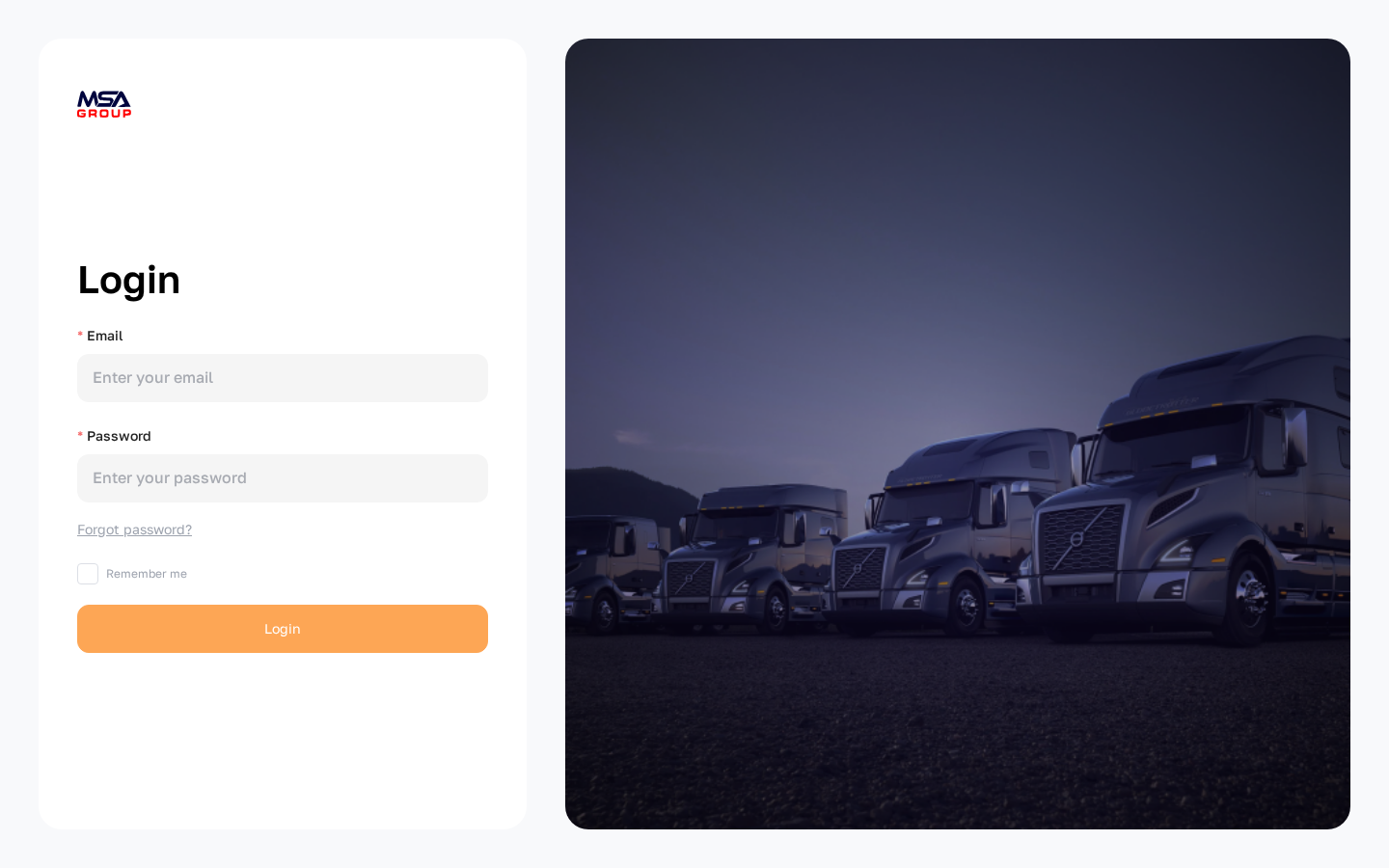
MSA TMS lives at app.tms.msagroupllc.com. Use your work email and password to sign in.
- Open the URL above in a modern browser (Chrome, Edge, or Safari).
- Enter your Email and Password.
- Tick Remember me if you'd like the browser to remember your email next time.
- Click Login.
If your account belongs to more than one carrier, you'll be asked to pick which one to work in for this session. You can change carrier later by logging out and back in.
Welcome dashboard
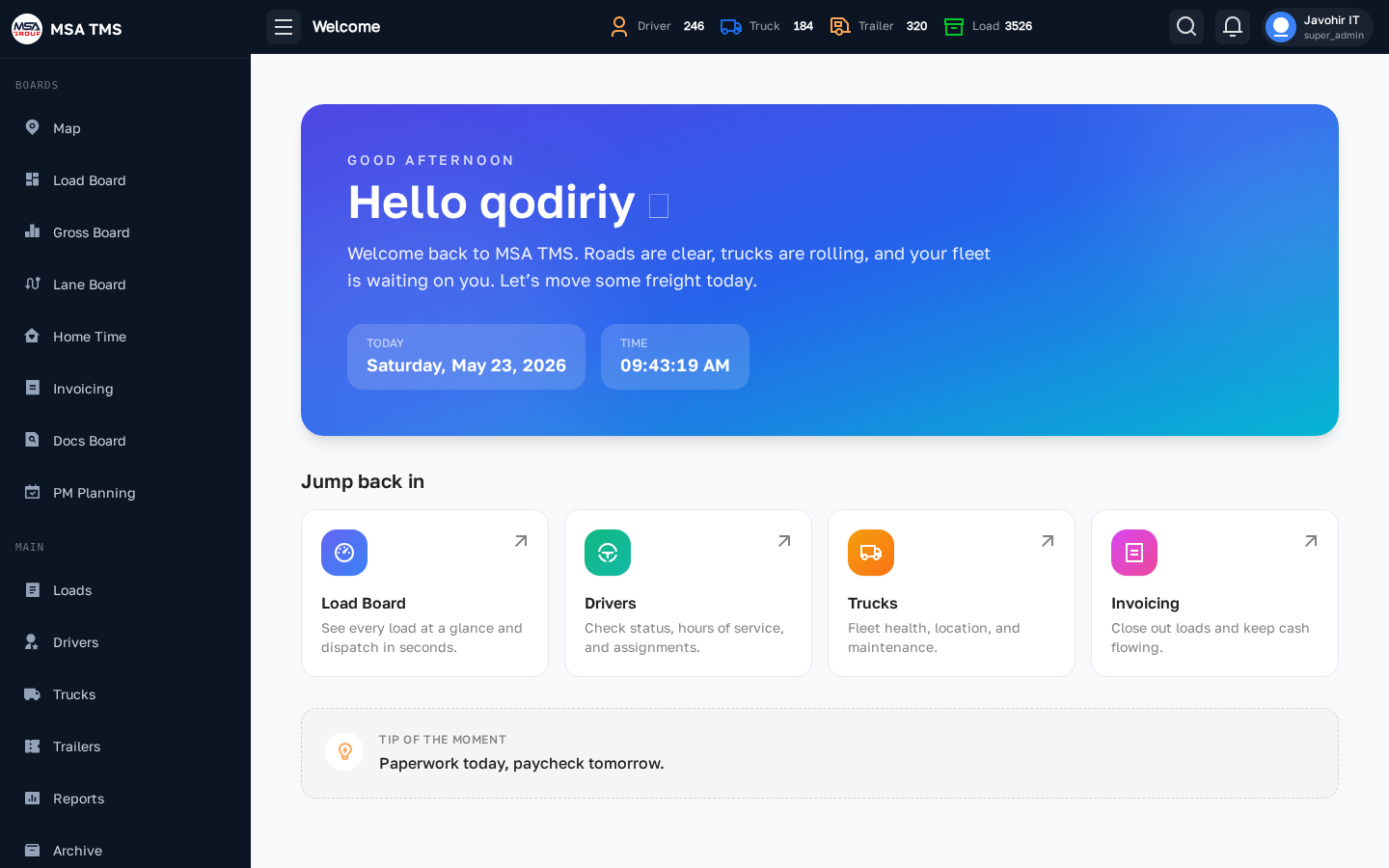
The first screen after login is the Welcome page. It greets you by name, shows the current date and time (Eastern Time), and surfaces a row of Jump back in shortcuts to the four most-used screens: Load Board, Drivers, Trucks, and Invoicing.
The top bar shows live counts of Drivers, Trucks, Trailers, and Loads so you can confirm the fleet size at a glance. Your profile menu is at the far right.
App layout
Every screen in the app uses the same shell:
- Left sidebar — your map of the app, grouped by area (Boards, Main, Dispatch, Fleet, Accounting, Safety, Settings). Click an item to open the page; the active item is highlighted in orange.
- Top bar — fleet counts, global search (🔎), notifications (🔔), and your profile menu.
- Main area — the page itself. Most pages combine filters on the top, a table or map below, and an Action column on the right of each row.
- Right drawer — when you edit a row (status, driver, truck, broker, etc.) the form slides in from the right rather than opening a pop-up dialog. Click outside or hit the Cancel button to dismiss.
📊 Boards
Boards are the operational dashboards — they pull live data from across the system and present it in the shape that team needs right now.
Map
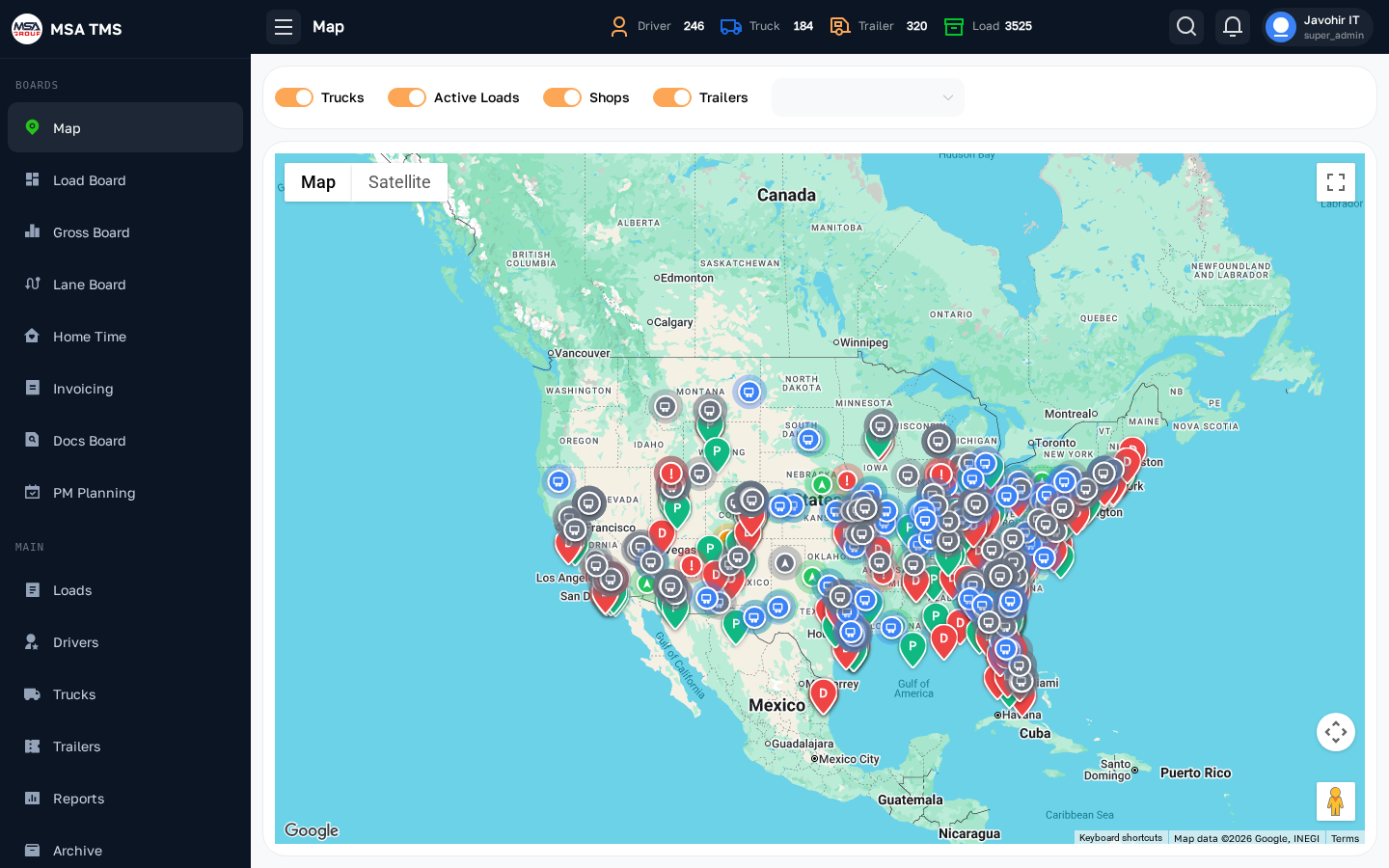
A live map of every truck in the fleet, with each pin showing the unit number, driver, current speed, and last update. Click a pin to reveal its route, recent stops, and any active load.
- Pan and zoom like any web map.
- Filter by driver, truck, or status from the toolbar.
- Lines drawn on the map represent ongoing trips, including pickup and delivery points.
Load Board
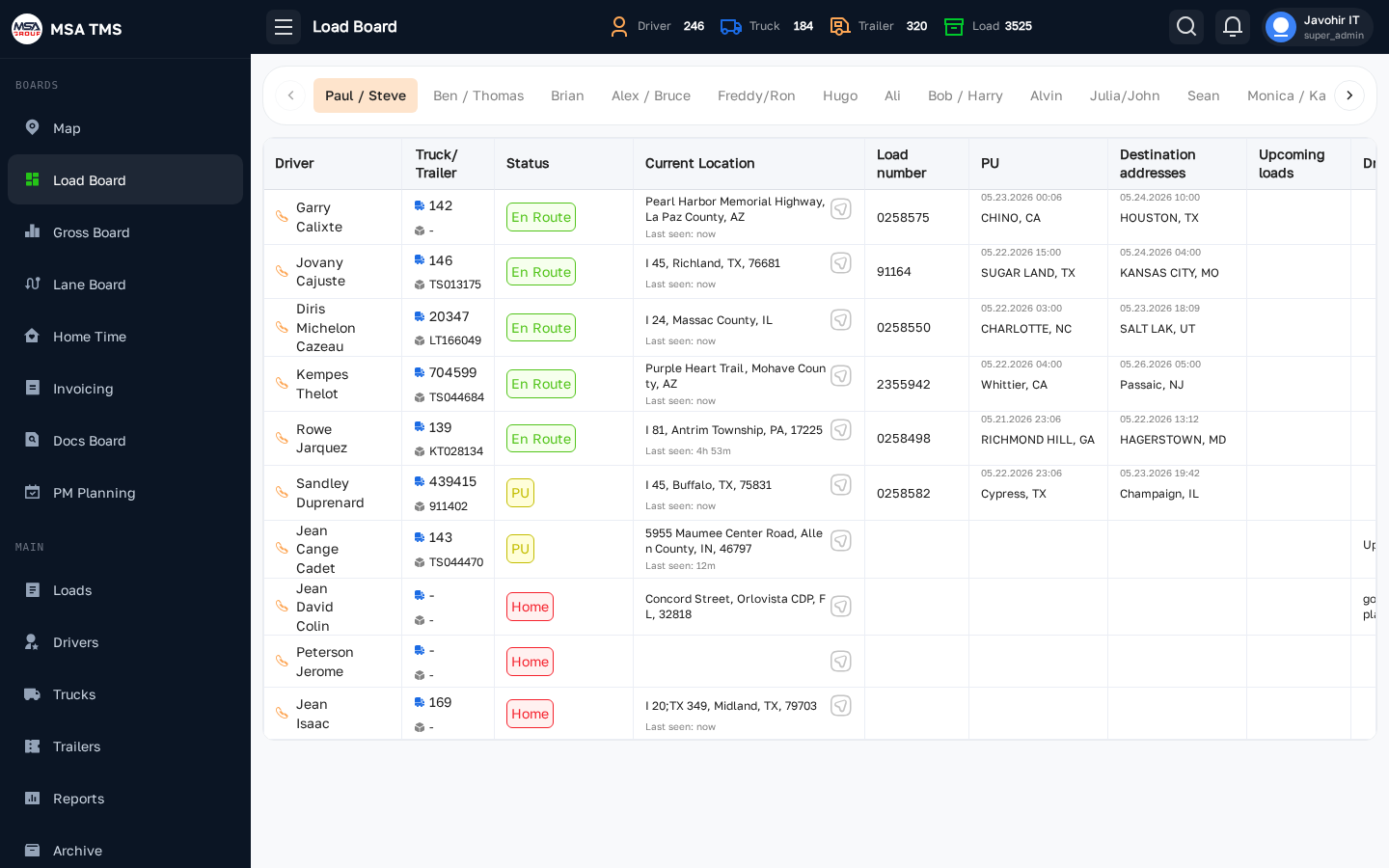
The dispatcher's home base. Every load currently in the system, in one table, with filters at the top for status, driver, truck, dispatcher, broker, dates, and more.
- Click a row to open the Load detail page.
- Use the column sort arrows to re-order by pickup, delivery, or rate.
- Inline status pills are colour coded — see Load statuses for the full legend.
Gross Board
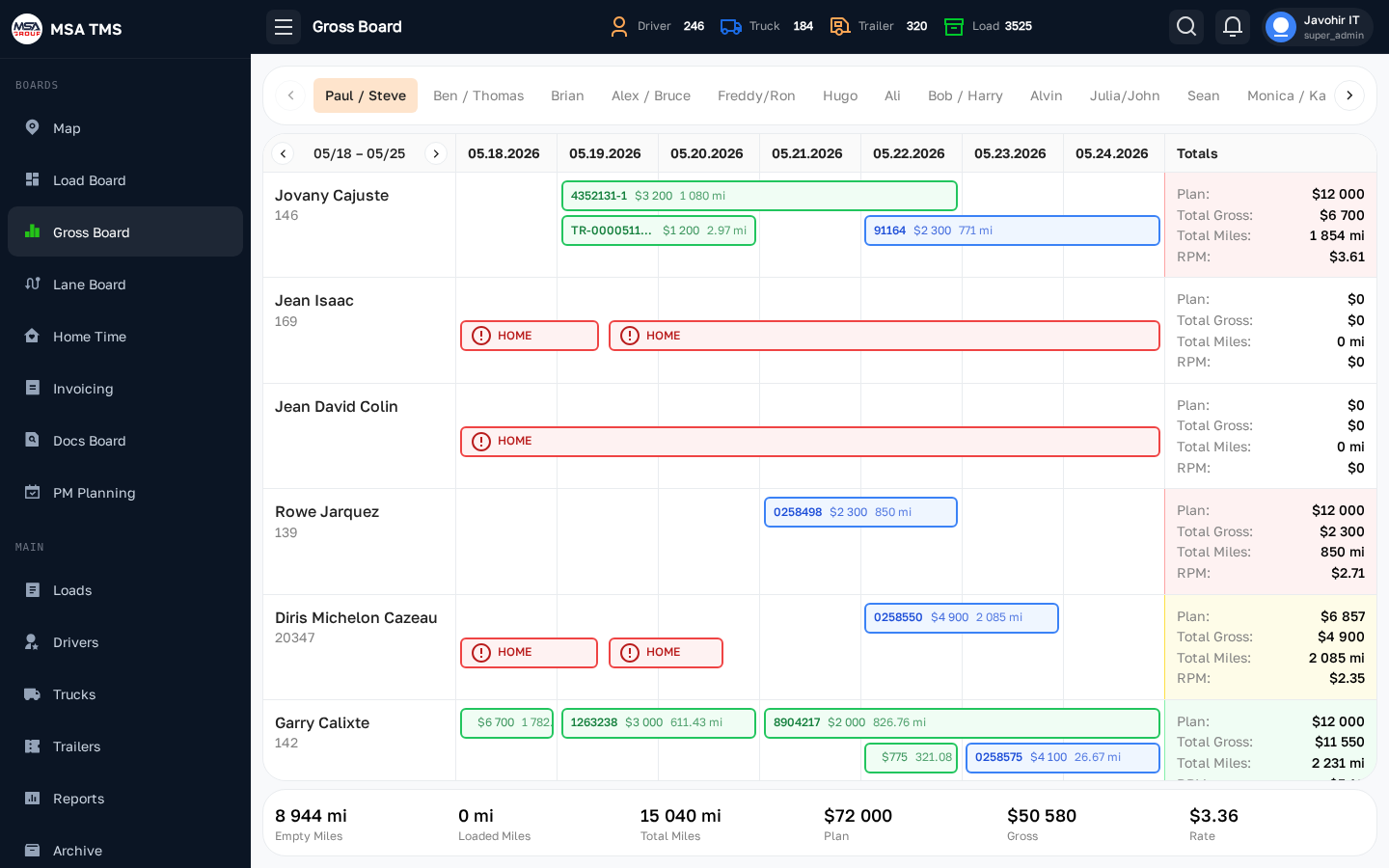
A weekly profitability scorecard. For each truck (or driver) the board shows total gross revenue, miles, rate per mile, deductions, and notes. The colours flag trucks that are over- or under-performing the threshold set in Settings → Gross Board.
- Switch between weeks with the date picker at the top.
- Click a row to expand the individual loads that contributed to the total.
- The notes column is shared with the dispatcher — leave a comment when re-classifying a load.
Lane Board
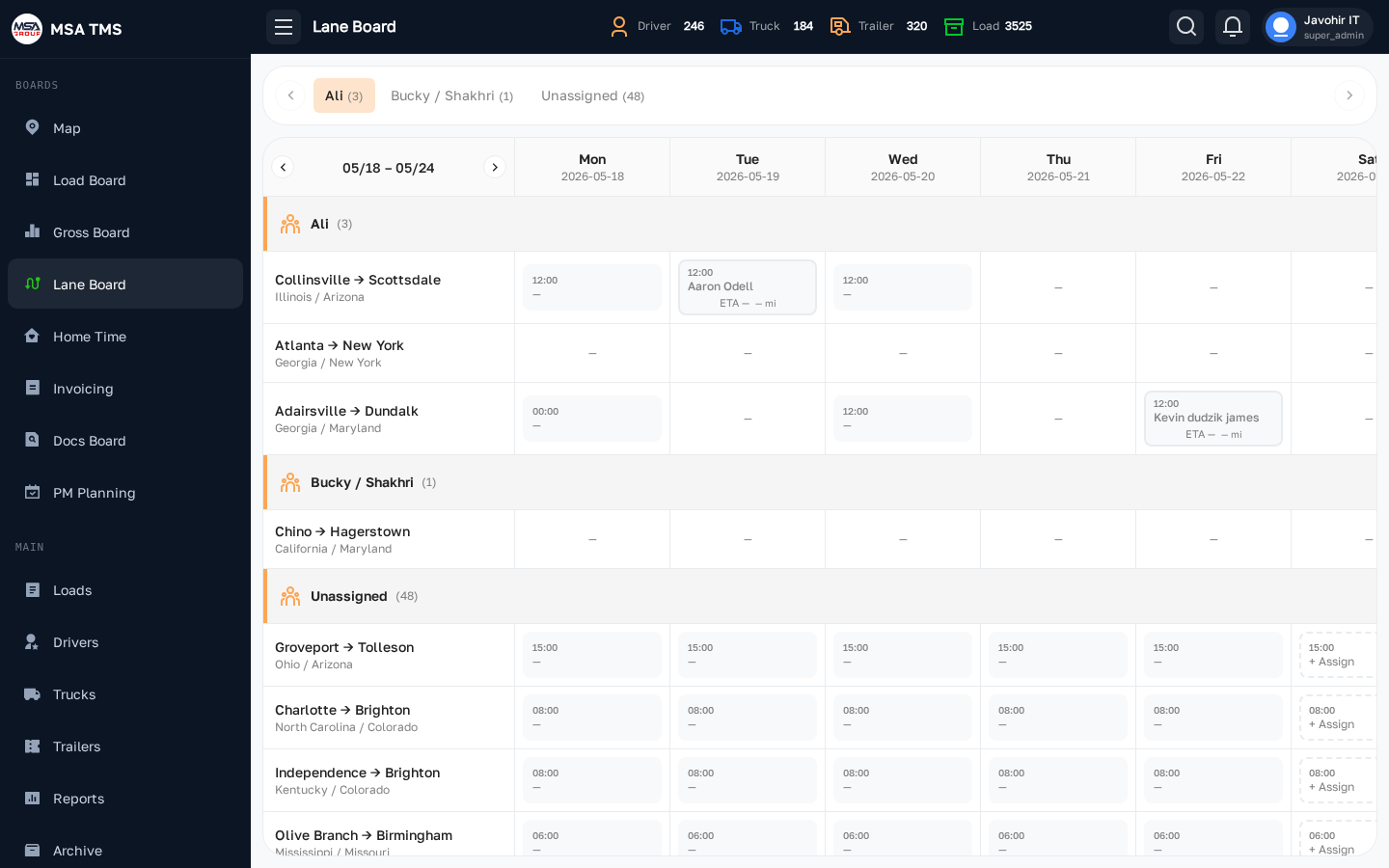
A view of your top-performing lanes (origin → destination pairs). Use it to spot where the company is making the most money per mile, where you have a backlog of trips, and where rates are dropping.
- Sort by gross, RPM, or trip count to find the most valuable lanes.
- Click a lane to see every load that ran it.
- Use the date filter to compare this month to last.
Home Time
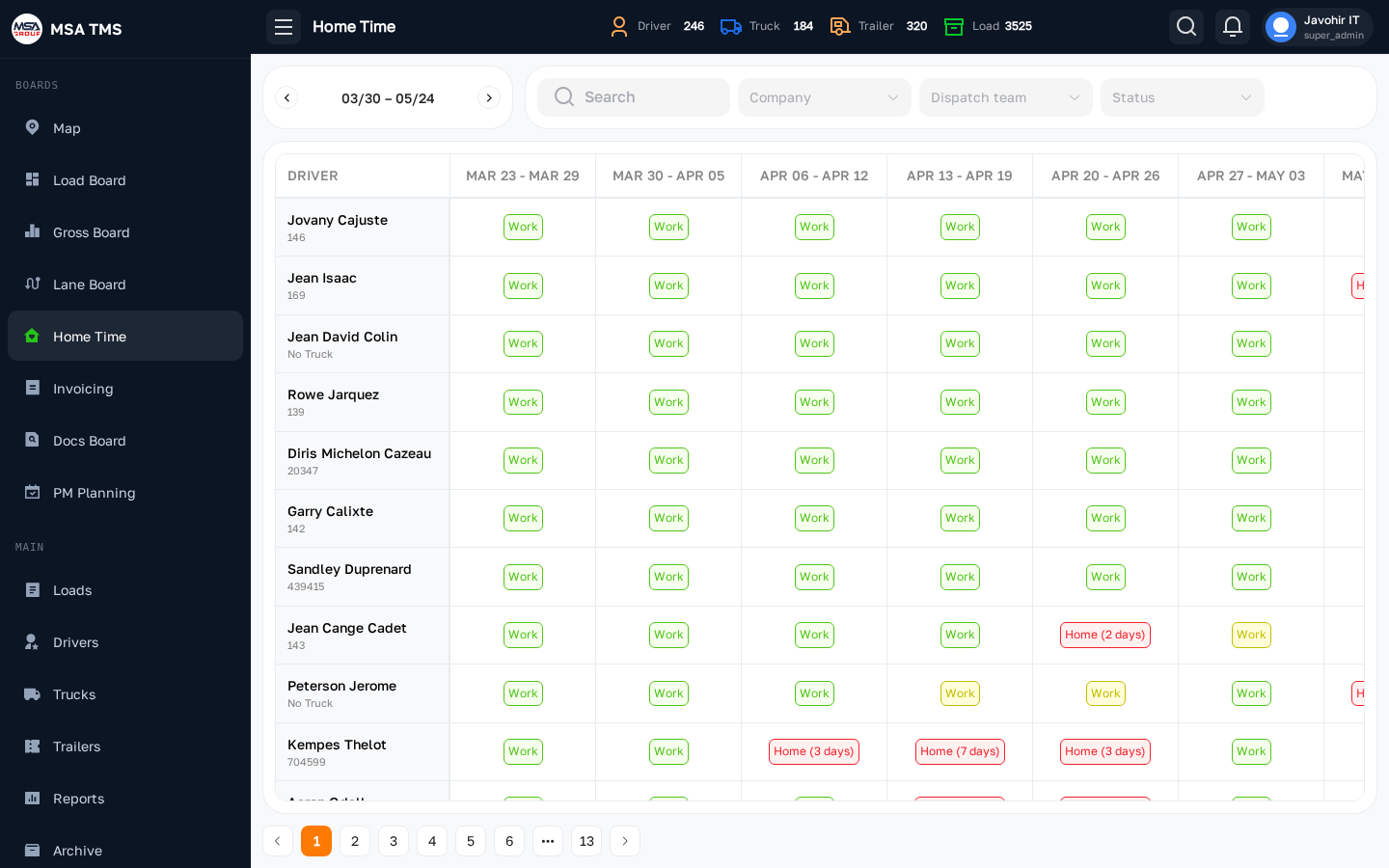
The driver vacation / home-time planner. Each row is a driver; the columns are days of the week. Use it to plan routing around drivers who'll be off, and to honour home-time requests.
- Click a cell to mark a driver as home / on the road / off.
- Hover for the driver's last and next planned home dates.
Invoicing
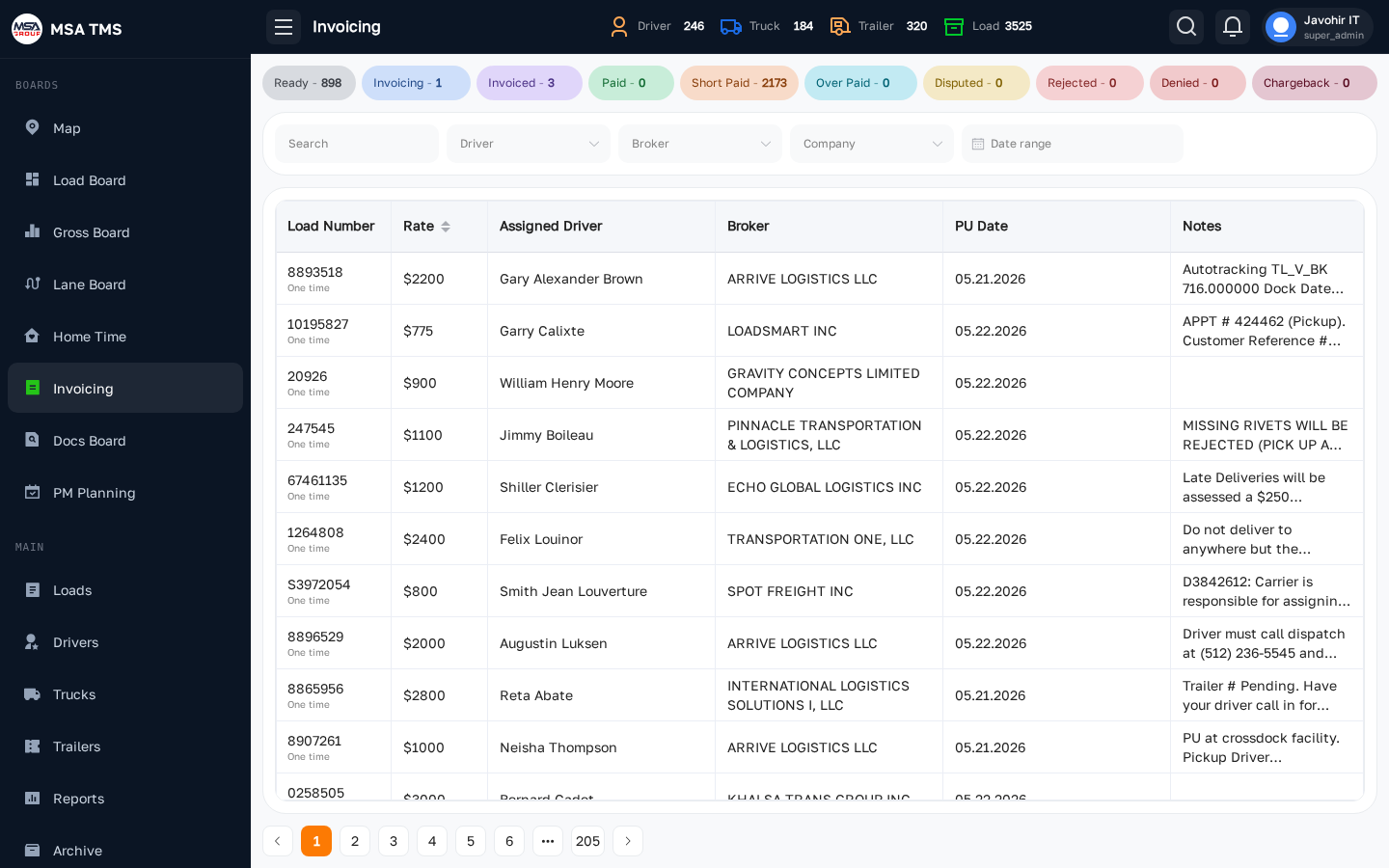
The accounting team's worklist for closing out loads and getting paid. Filter by broker, dispatcher, or invoice status (Pending, Invoiced, Paid). For each load you can review the rate confirmation, BOL, and any photo control evidence before sending the invoice.
- Send invoices in bulk by selecting rows and using the Action menu.
- Mark paid loads from the row's edit drawer — this updates the related Gross Board calculation.
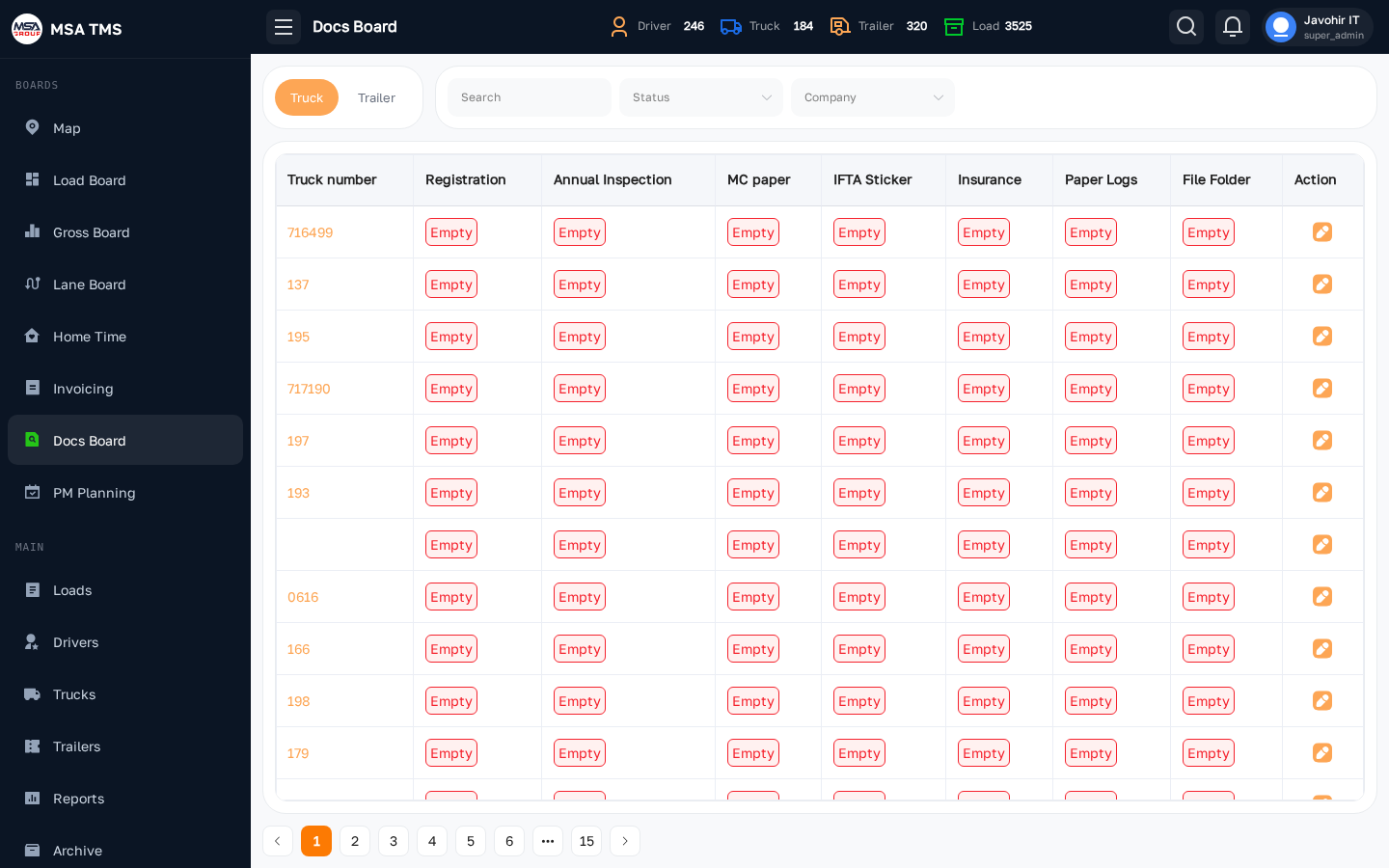
Docs Board
A documentation health board — for each load it shows what's uploaded and what's missing (Rate Confirmation, BOL, POD, lumper receipts, scale tickets, photo control). Red badges mean a document is missing; green means uploaded.
- Click a row to jump straight to the load's Documents tab.
- Use this board the day before invoicing to make sure nothing's missing.
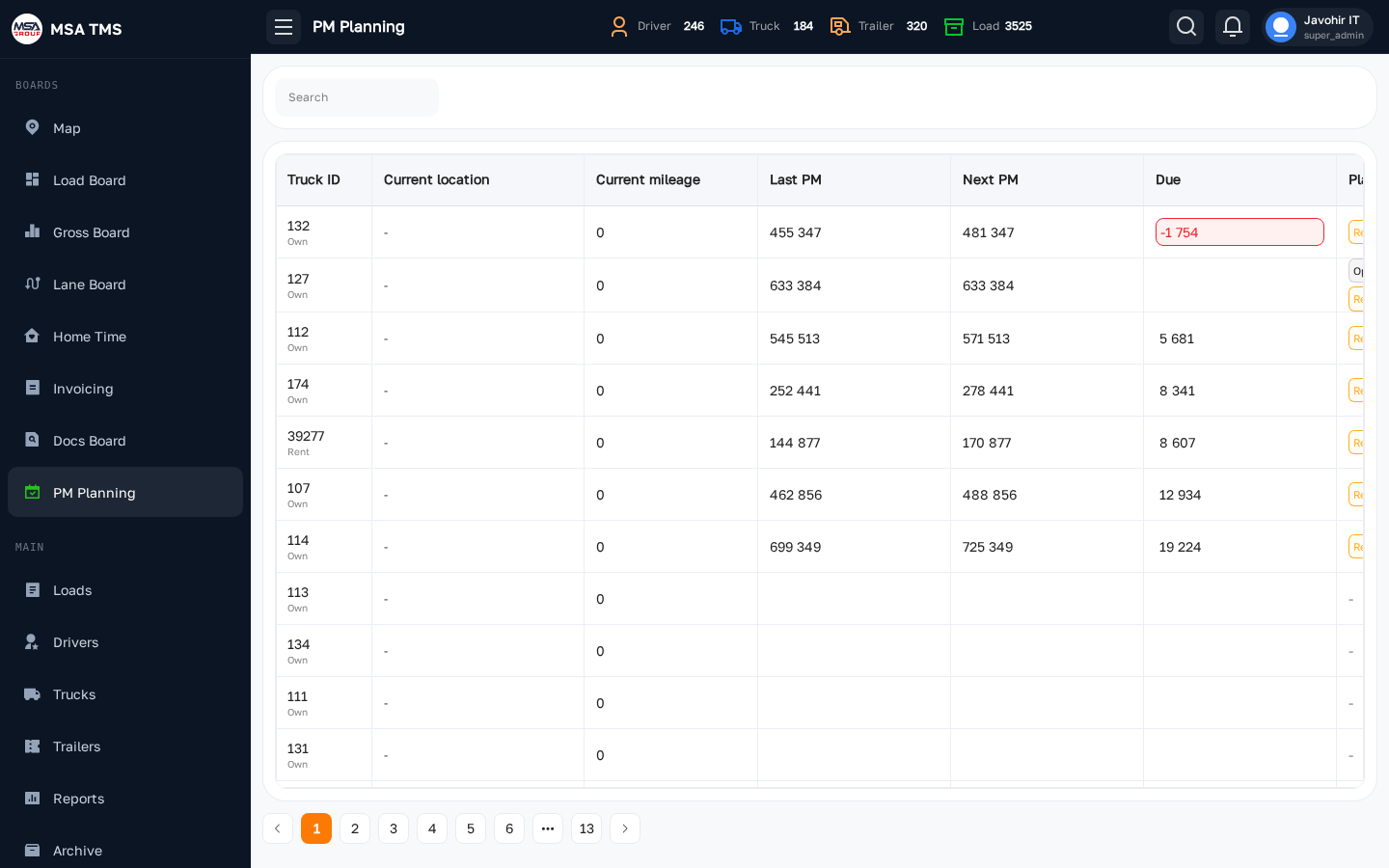
PM Planning
A forward-looking maintenance calendar. PM (Preventive Maintenance) schedules from the Fleet module are projected onto a calendar so you can plan which trucks come off the road in which week.
- Filter by PM type (A-service, B-service, DOT inspection, etc.).
- Click an event to open the PM record in Fleet → PM.
📁 Main
Main is where the core data lives. Anything you read in a board is created and edited here.
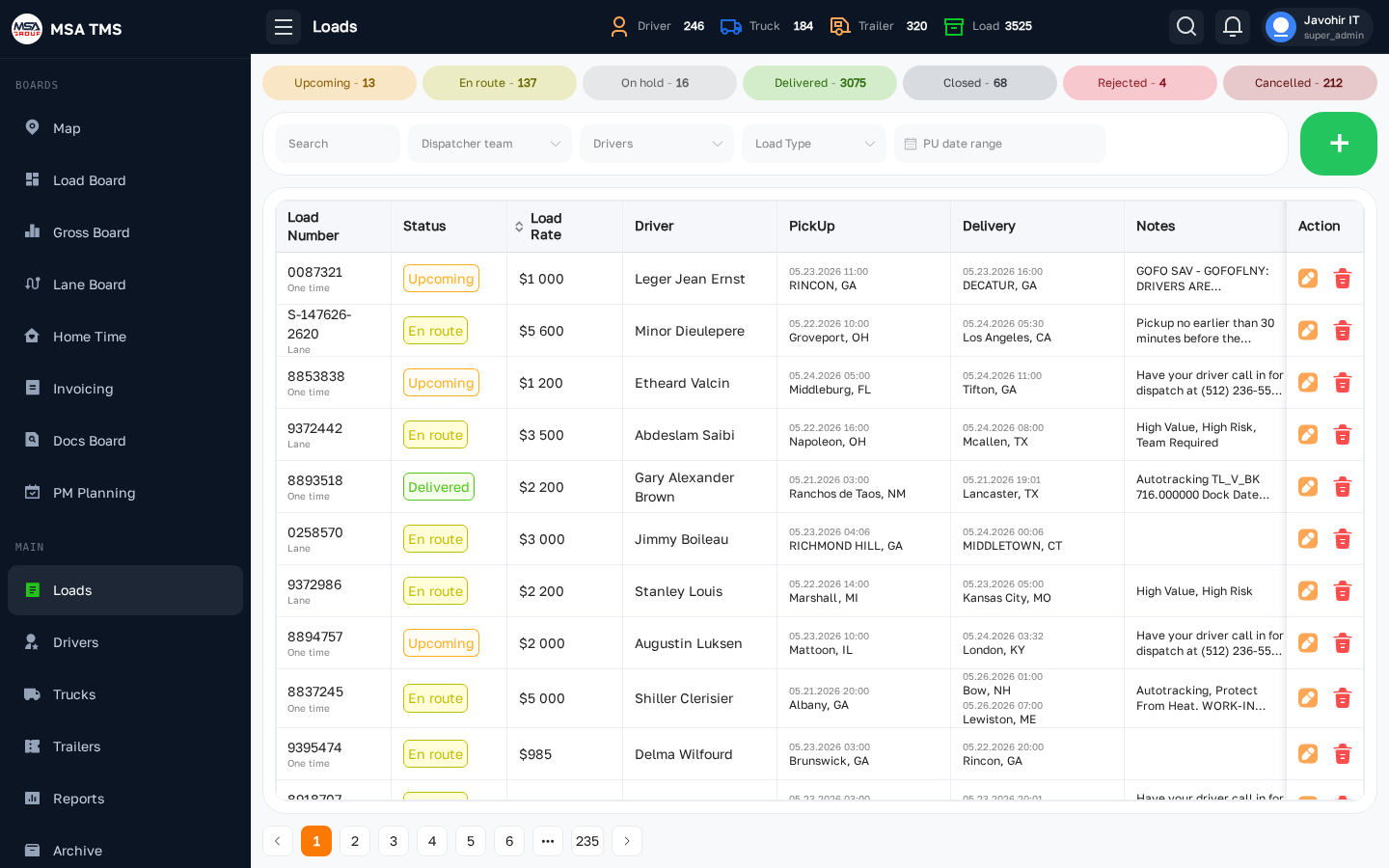
Loads
The full loads ledger. Create a new load (top-right button), search and filter existing loads, and open any one of them for a detailed view.
The Load detail page is the most-edited surface in the system. From there you can:
- Assign and re-assign drivers, trucks, and trailers.
- Change the load status (Upcoming → En Route → Delivered → Closed).
- Upload Rate Confirmation, BOL, POD, and lumper receipts.
- Edit the rate, deadhead, broker, lane, and notes.
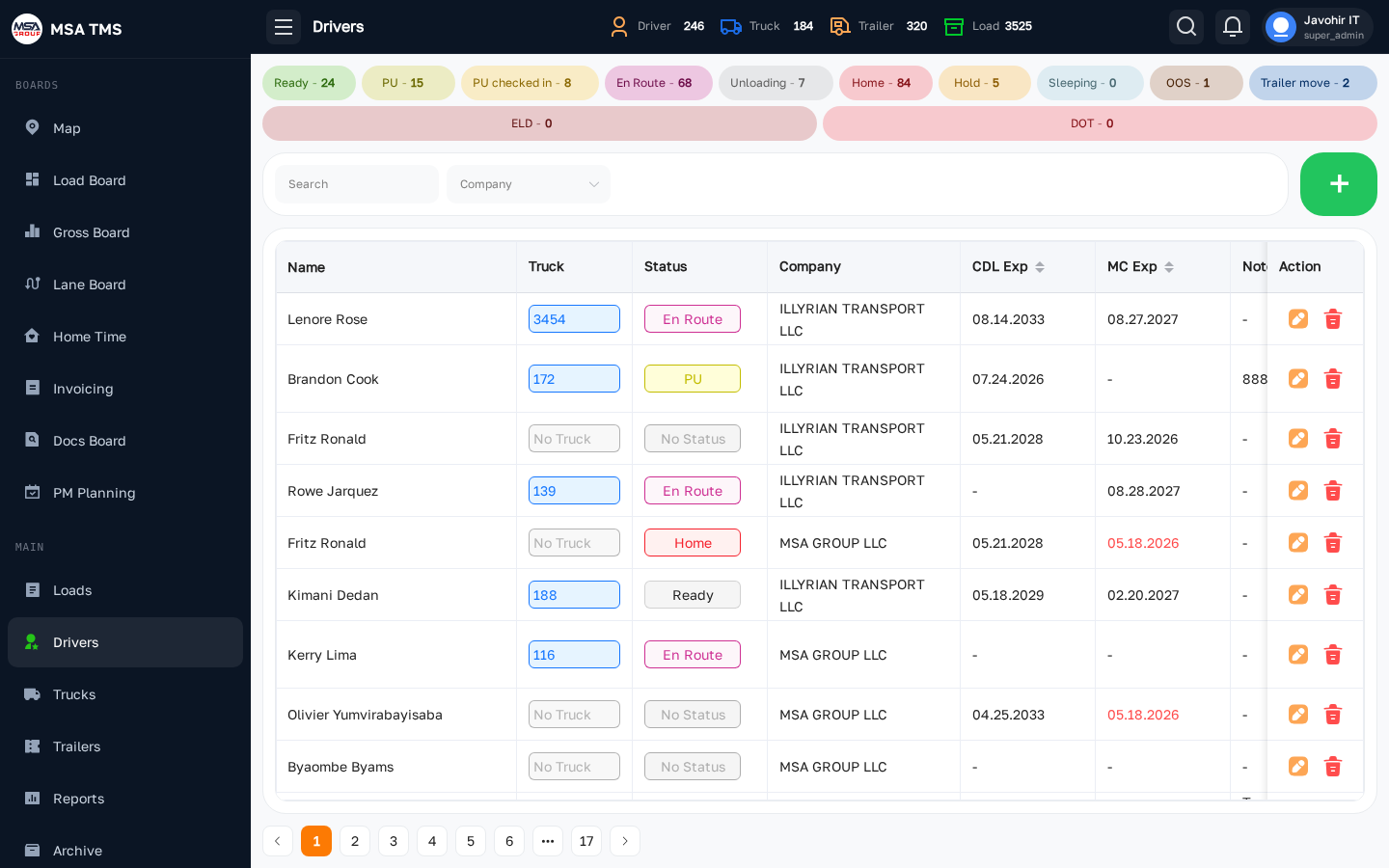
Drivers
The driver roster. For each driver you can open a profile page with personal info, CDL, medical, payroll (% per load or per mile), assigned truck, hours of service, contacts, and uploaded documents.
- + New driver — onboarding wizard for a brand-new driver.
- Filter by employment status (Active, Terminated, Onboarding).
- Open a driver to manage hold/release, vacation, and pay history.
Trucks
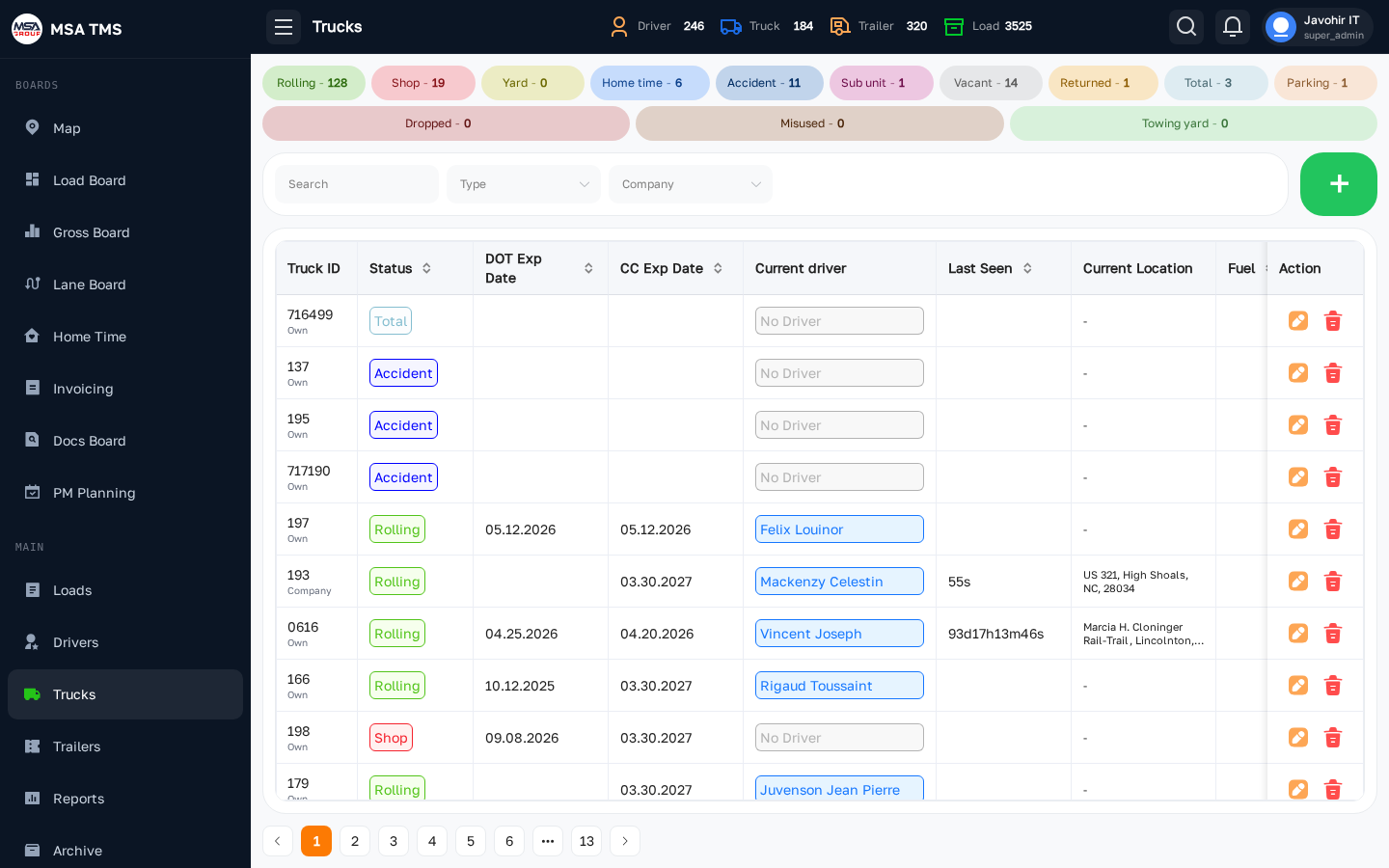
Every power unit in the fleet. A truck record holds VIN, plate, make and model, annual registration, ownership (owned / leased / O/O), assigned driver, and any attached devices (Samsara, Azuga, etc.).
From a truck record you can:
- Assign or unassign a driver.
- Open the truck's PM schedule, repair history, fuel-card transactions.
- Add documents (registration, IFTA, annual inspection, plates).
Trailers
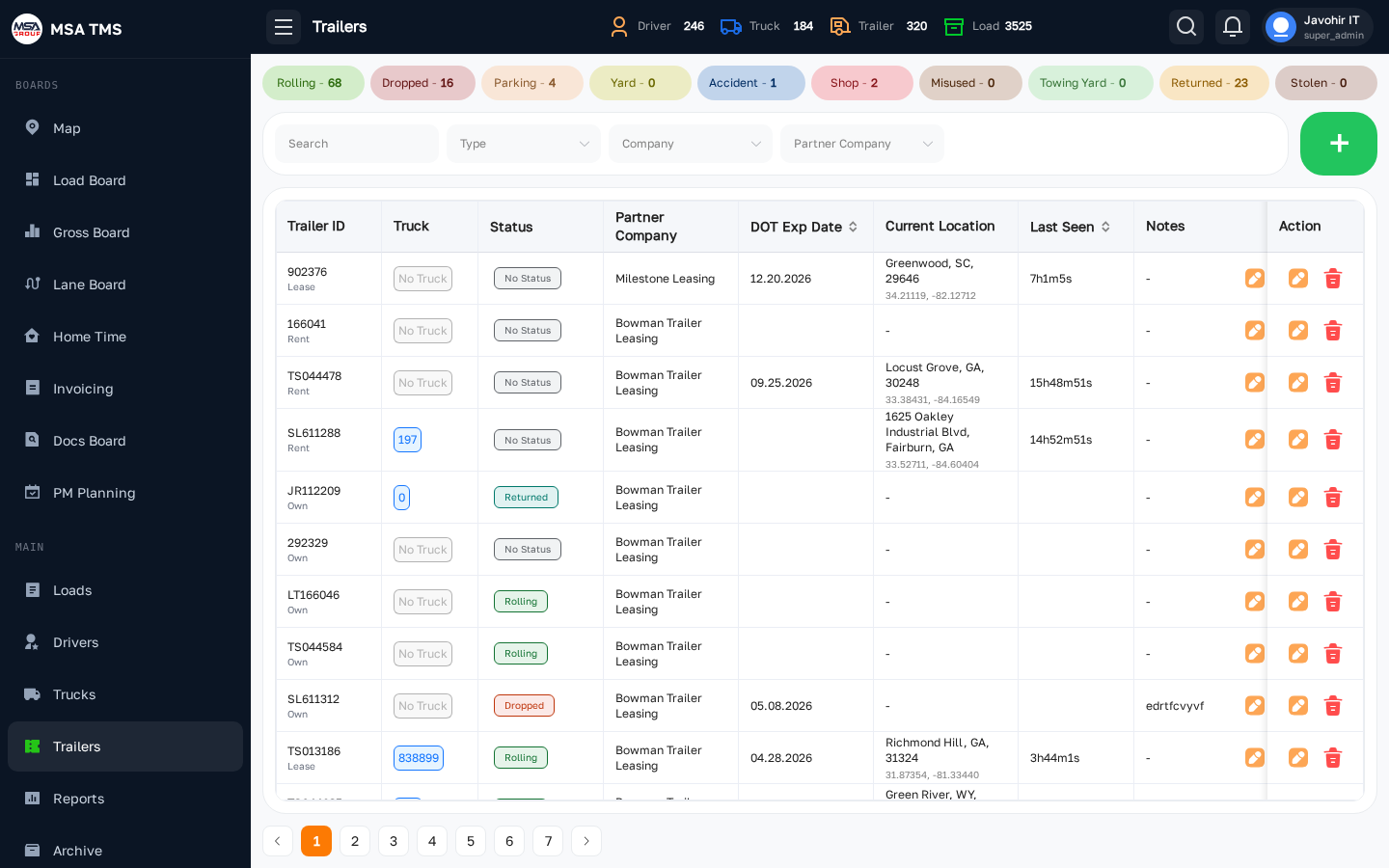
Every trailer in the fleet. Mirrors the Trucks page: VIN, plate, type (Dry Van, Reefer, Flatbed), ownership, current assignment, and documents.
- Use the Type filter to find an available Reefer for a temperature-controlled load.
- Trailer history shows which truck pulled it and when.
Reports
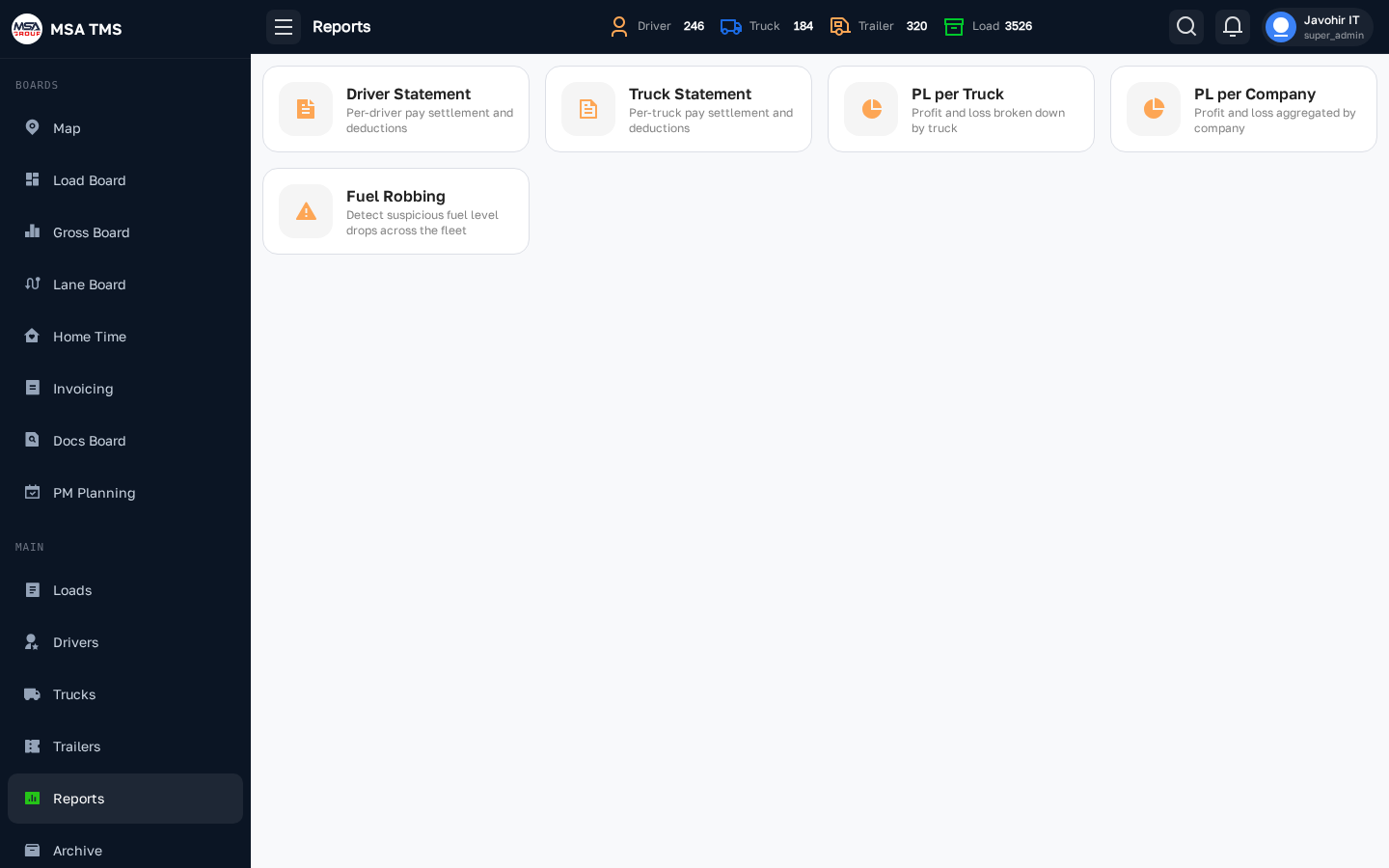
A hub of pre-built reports — driver pay, gross, dispatcher commission, broker analysis, lane analysis, and more. Pick a report card to open it, choose a date range, and export to Excel / PDF.
- Reports run against live data so they always match the current state.
- Save common filter sets as bookmarks (browser URL captures filter state).
Archive
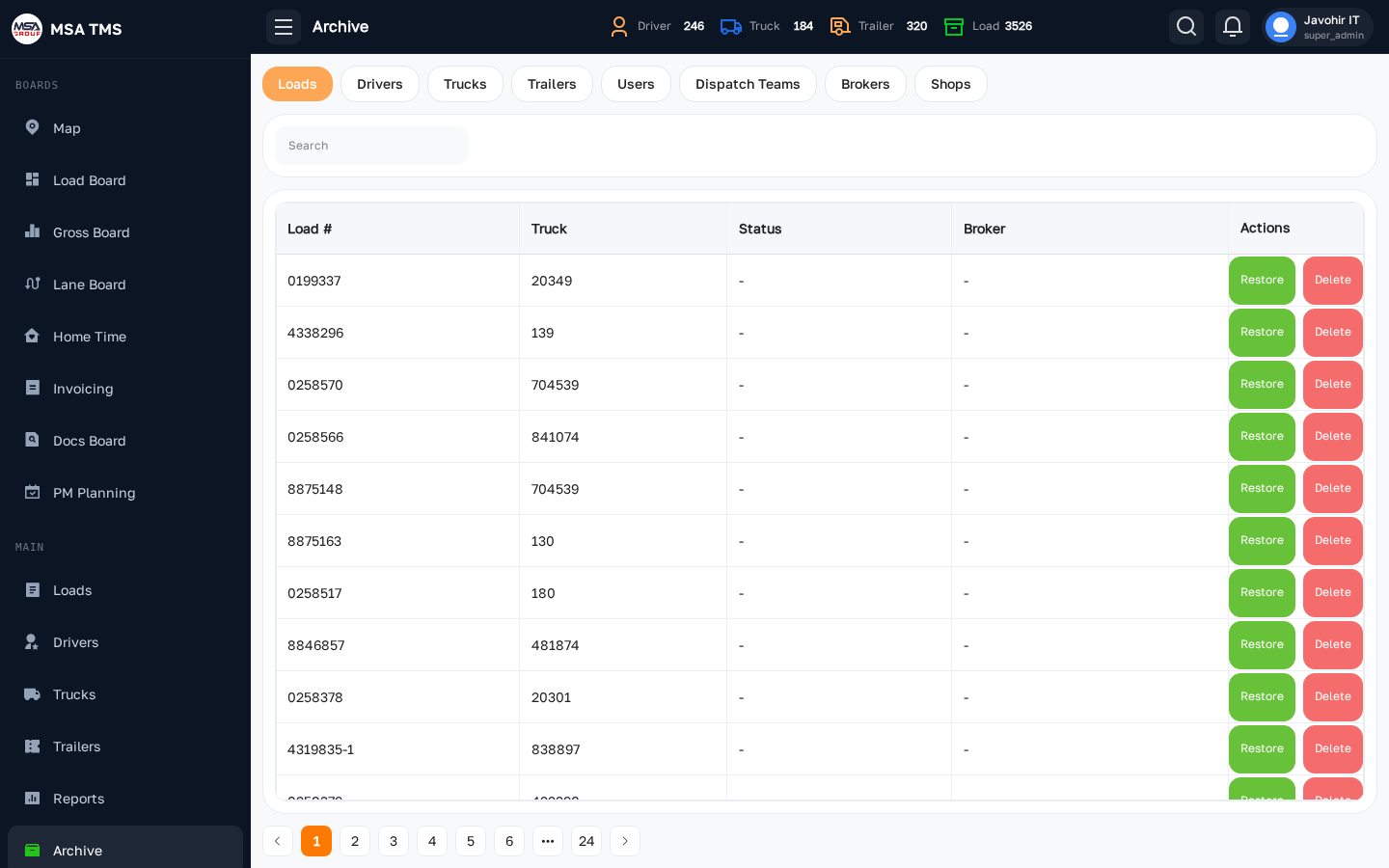
Where Closed loads go after you mark them. The Archive is read-only — open a load to review the final invoice and documents, but you can't edit financial figures. Use it during audits or to look up an old POD.
🚚 Dispatch
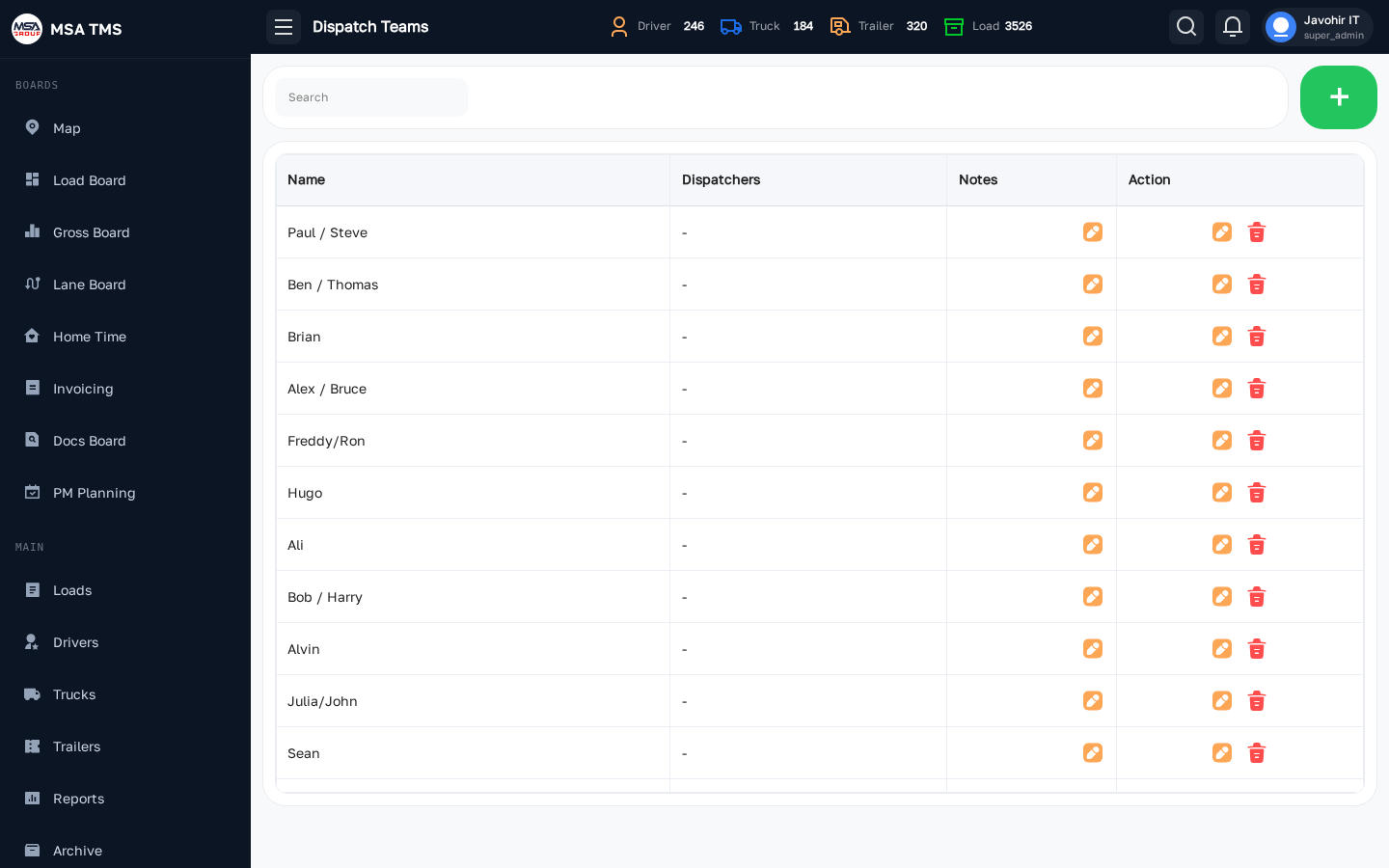
Dispatch Teams
Group dispatchers into teams (e.g. Day Shift, Night Shift, Reefer Desk). Each team has members and the trucks/drivers they own. The team a load is dispatched by is what feeds the dispatcher-commission report.
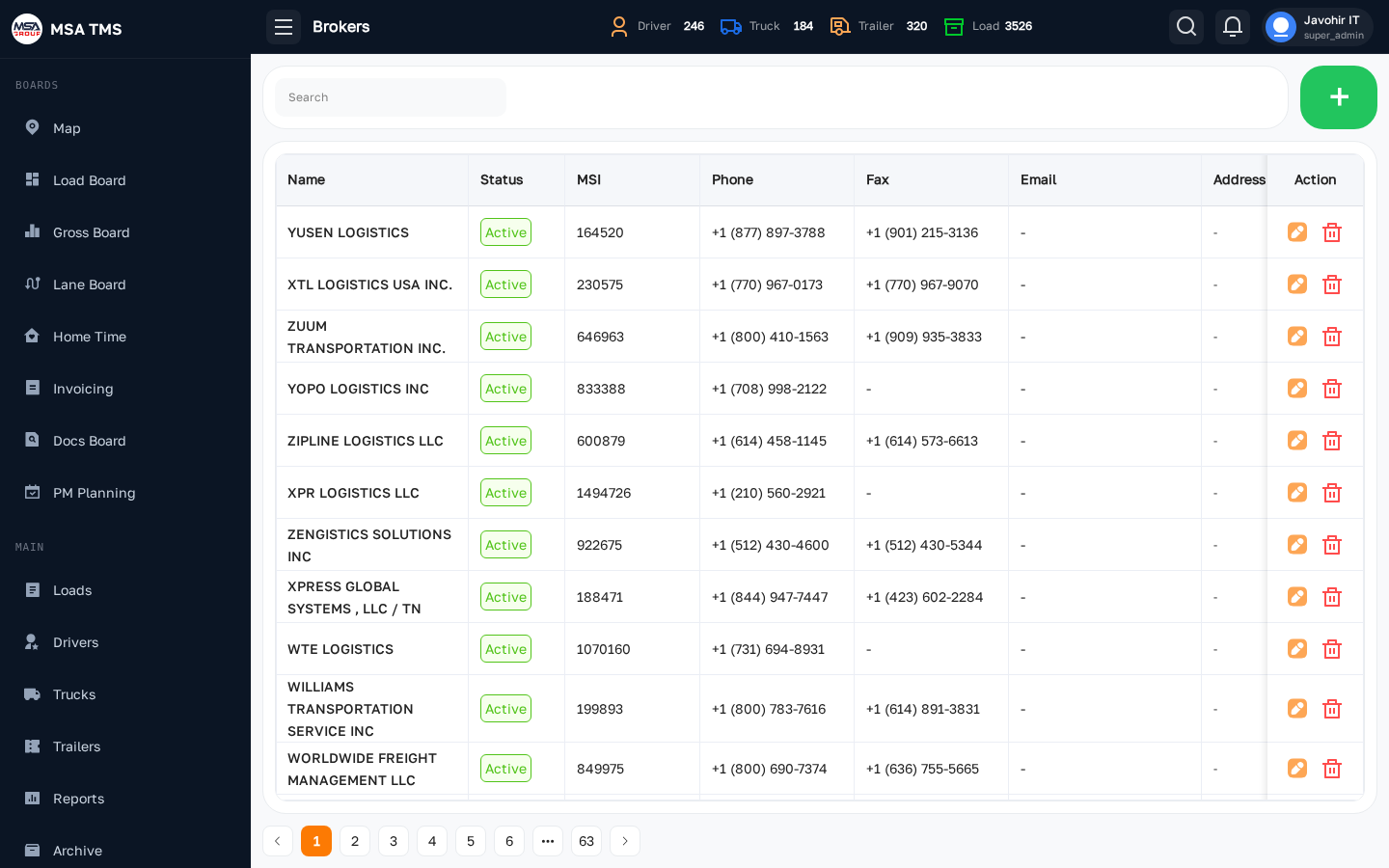
Brokers
The brokers and shippers you do business with. Each broker record stores MC number, contact info, factoring company, and rate history. When you create a load you pick a broker from this list.
- Use the + New broker button to add a brand-new partner.
- Open a broker to see every load you've ever run for them.
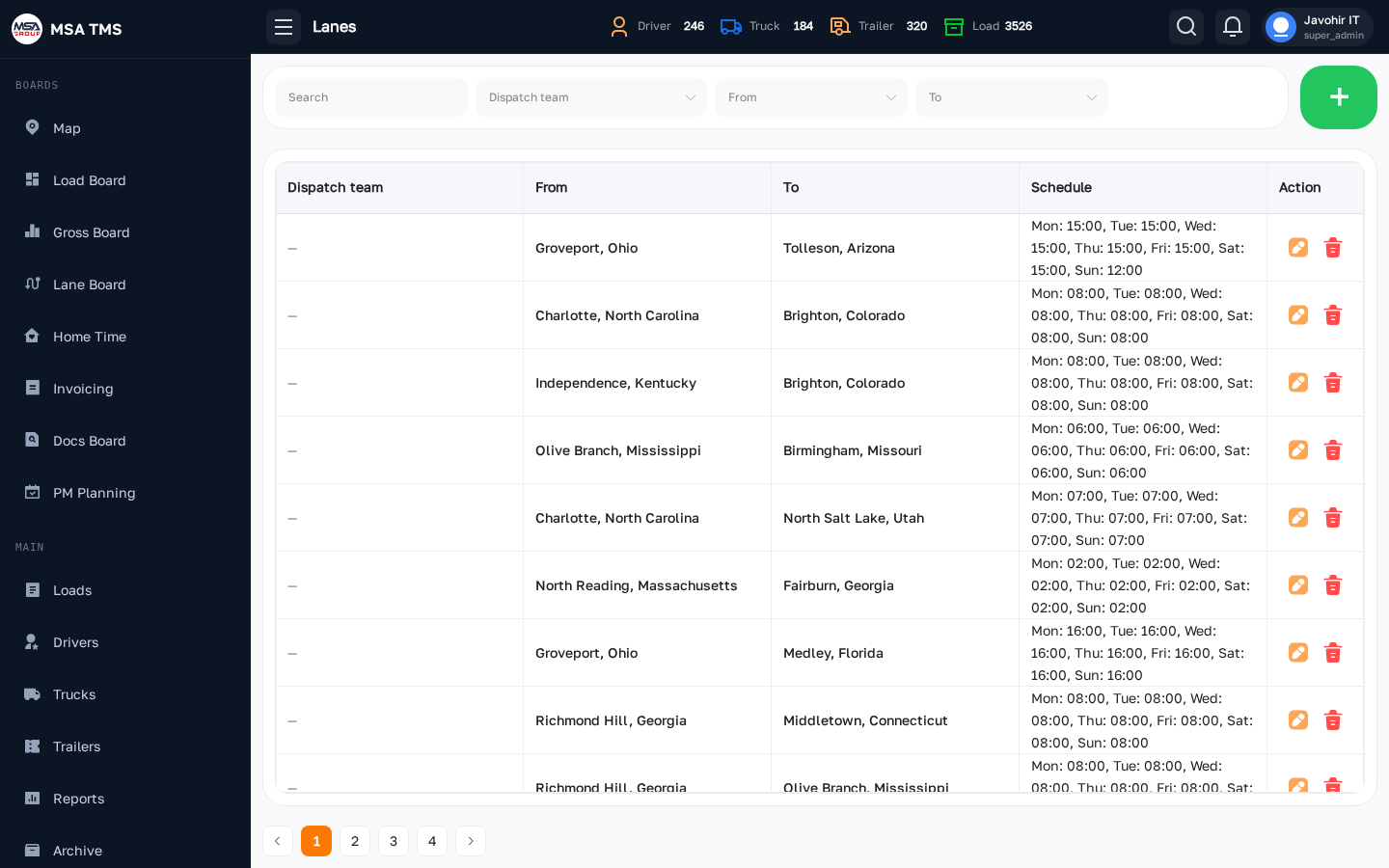
Lanes
Named lanes (origin → destination, e.g. ATL → MIA). Used both for reporting and as a quick pick when creating a load. Lanes link to recurring broker contracts.
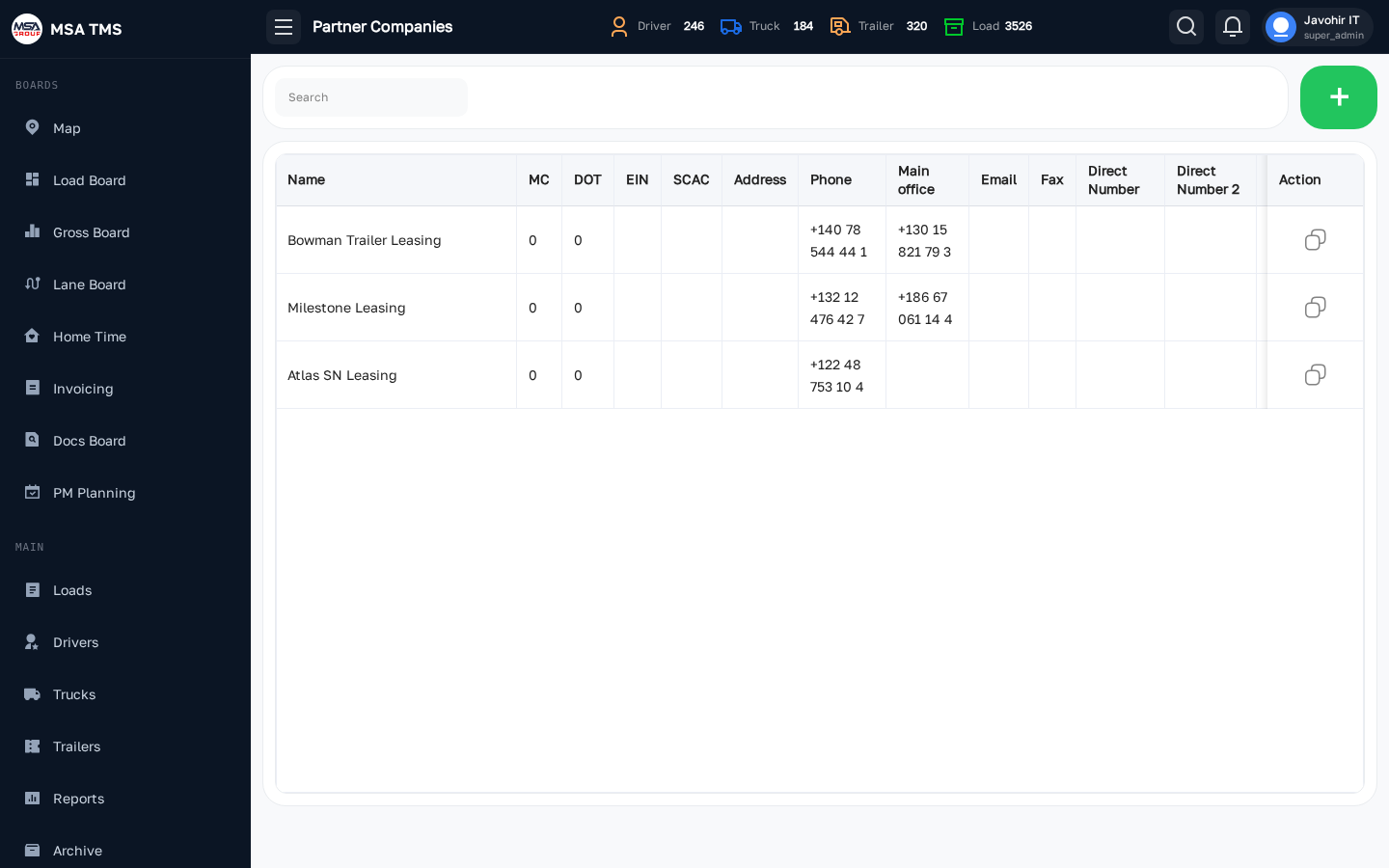
Partner Companies
Other carriers you partner with — outsourcing loads, leasing trucks, or running drop-and-hook arrangements. Each partner record stores their MC, COI, and the contact people you deal with.
🔧 Fleet
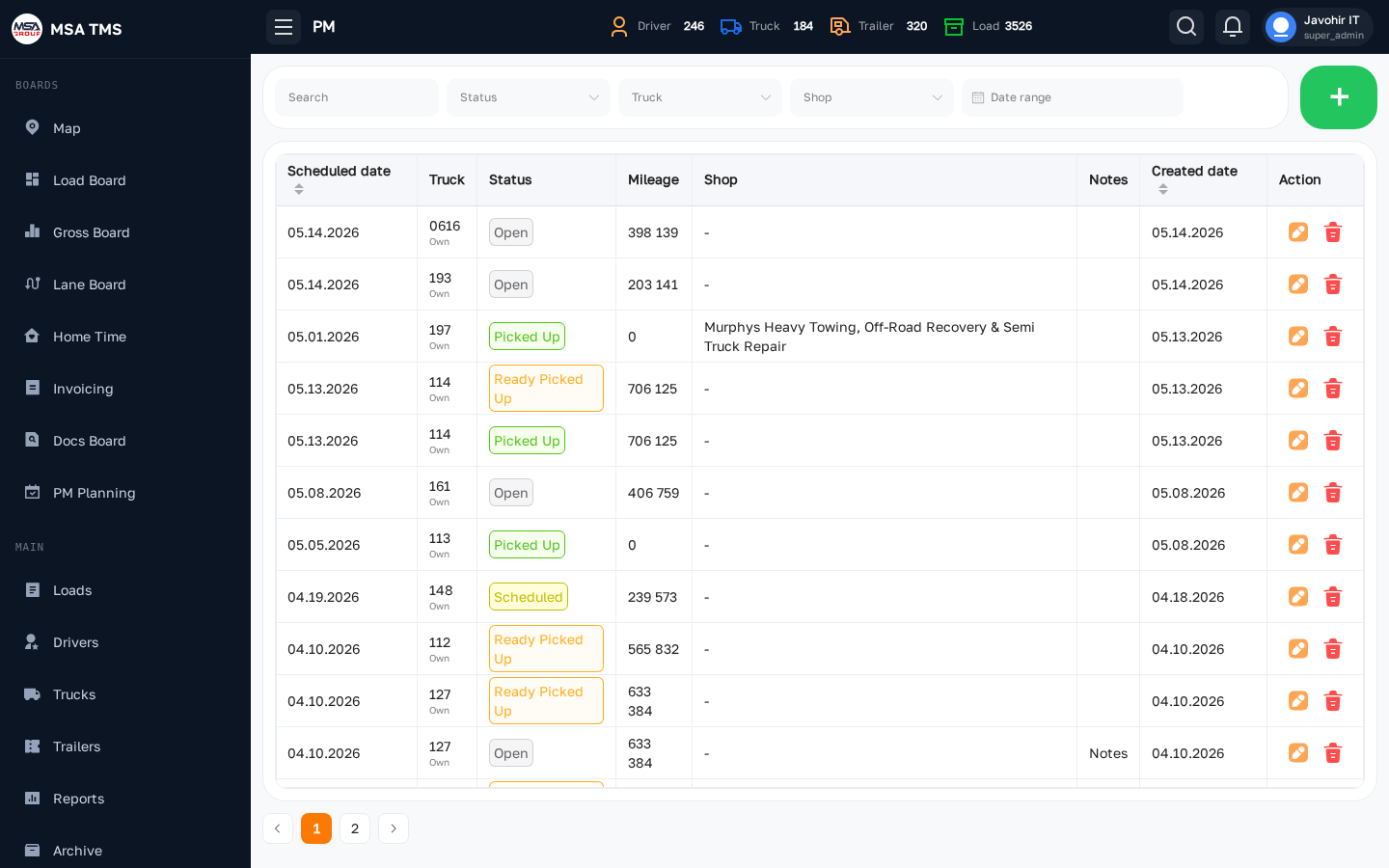
PM (Preventive Maintenance)
Scheduled maintenance for every truck and trailer. Each row shows the unit, the next due date or mileage, and the current state (Upcoming, Due, Overdue, Done).
- Click a row to open the PM record and mark it complete with cost and receipt.
- PMs feed both the PM Planning calendar and the unit expenses.
Repair
A live ticket of every truck or trailer currently in or recently out of the shop. Top tabs let you switch between Truck and Trailer. Filters on the right narrow by shop, mechanic, status (In Shop, Diagnosing, Done), and date.
- + New repair — opens a form to log a unit going to the shop.
- Attach photos and the shop's invoice; cost flows into Accounting.
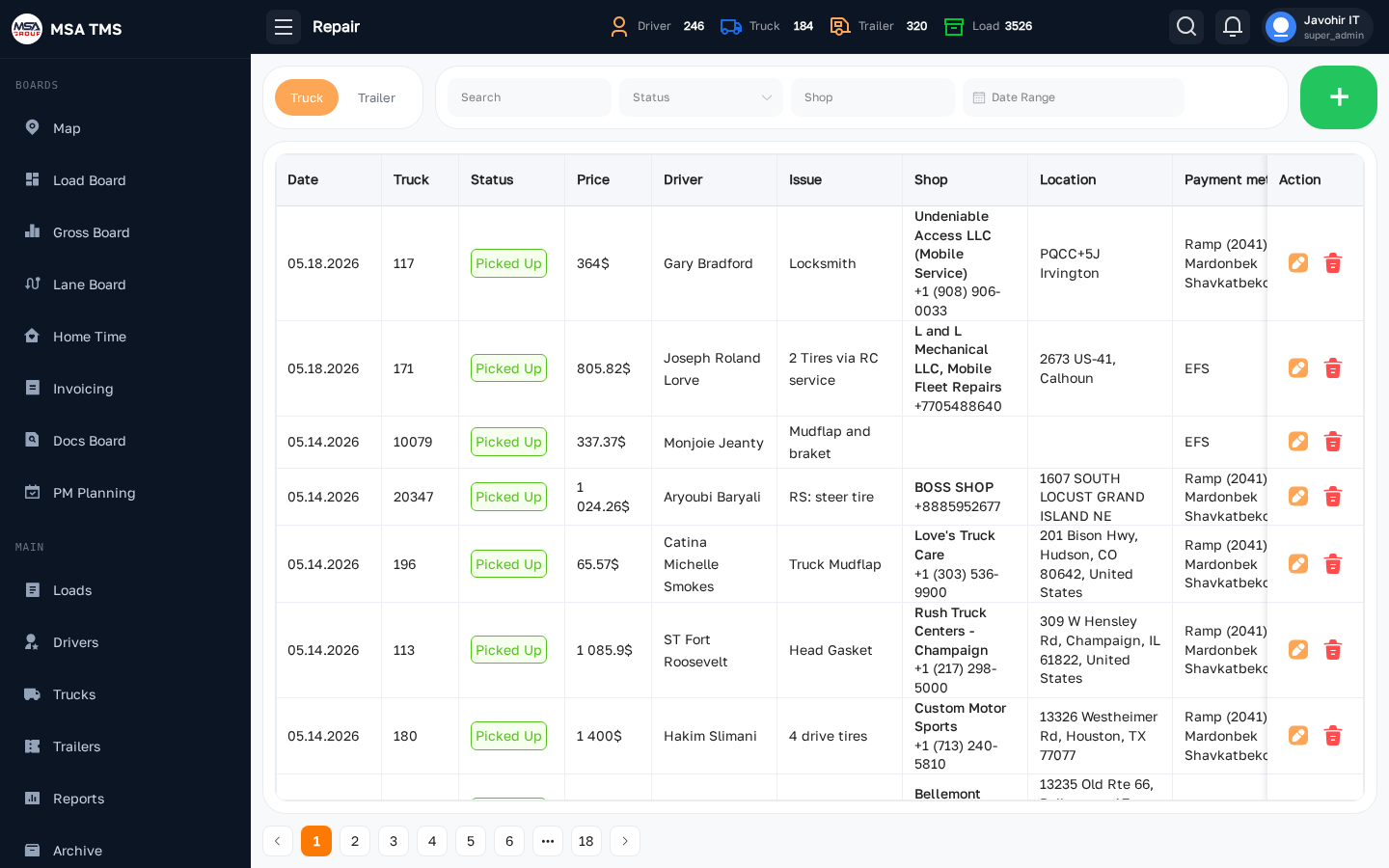
Photo Control
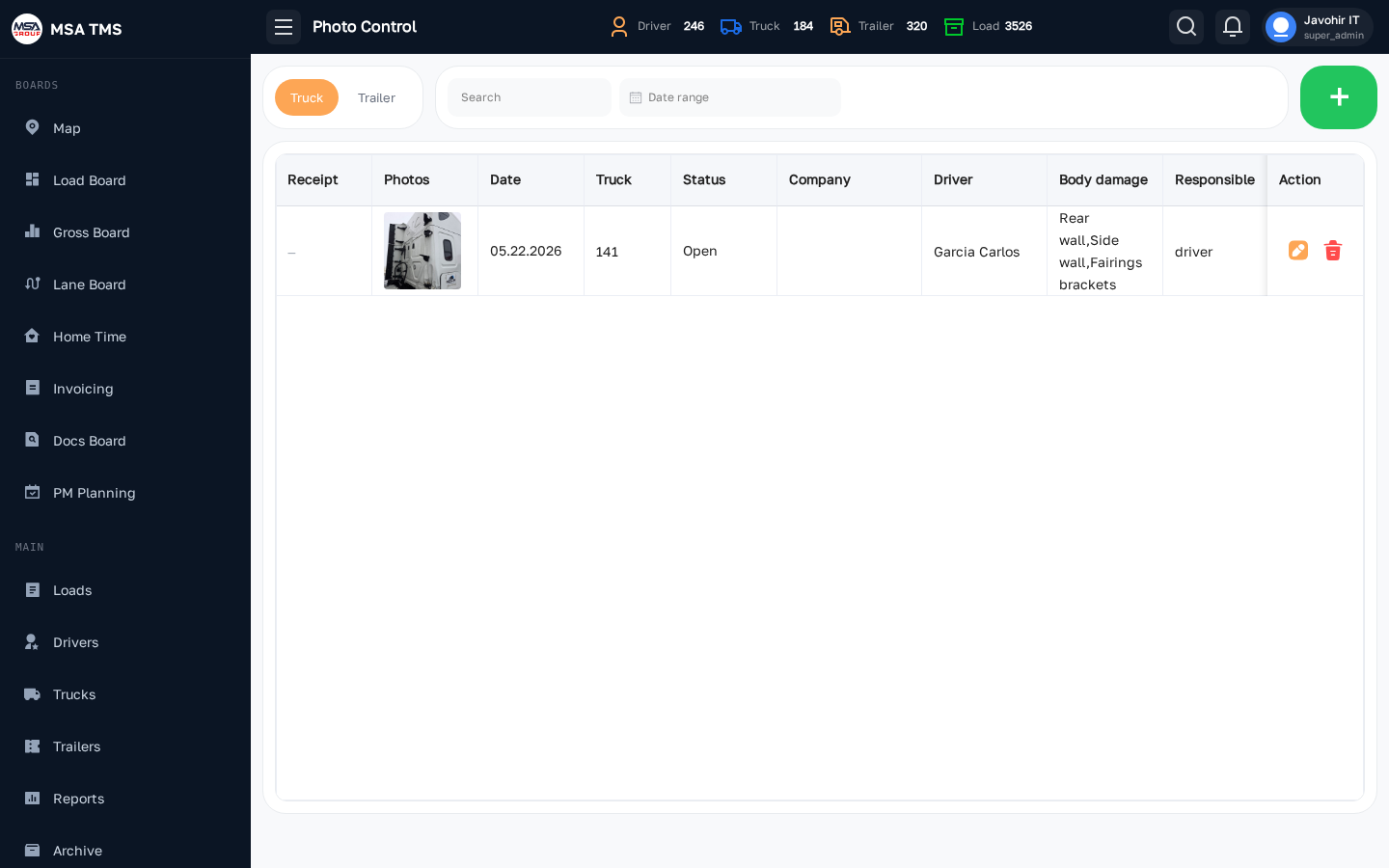
Drivers upload photos of the truck and trailer (interior, exterior, tires) at regular intervals. Photo Control is where Safety and Fleet review those submissions, flag issues, and follow up with the driver.
- Filter by date and driver to spot drivers who missed a check.
- Use the inline approve/reject buttons; comments are visible to the driver.
Fuel Card
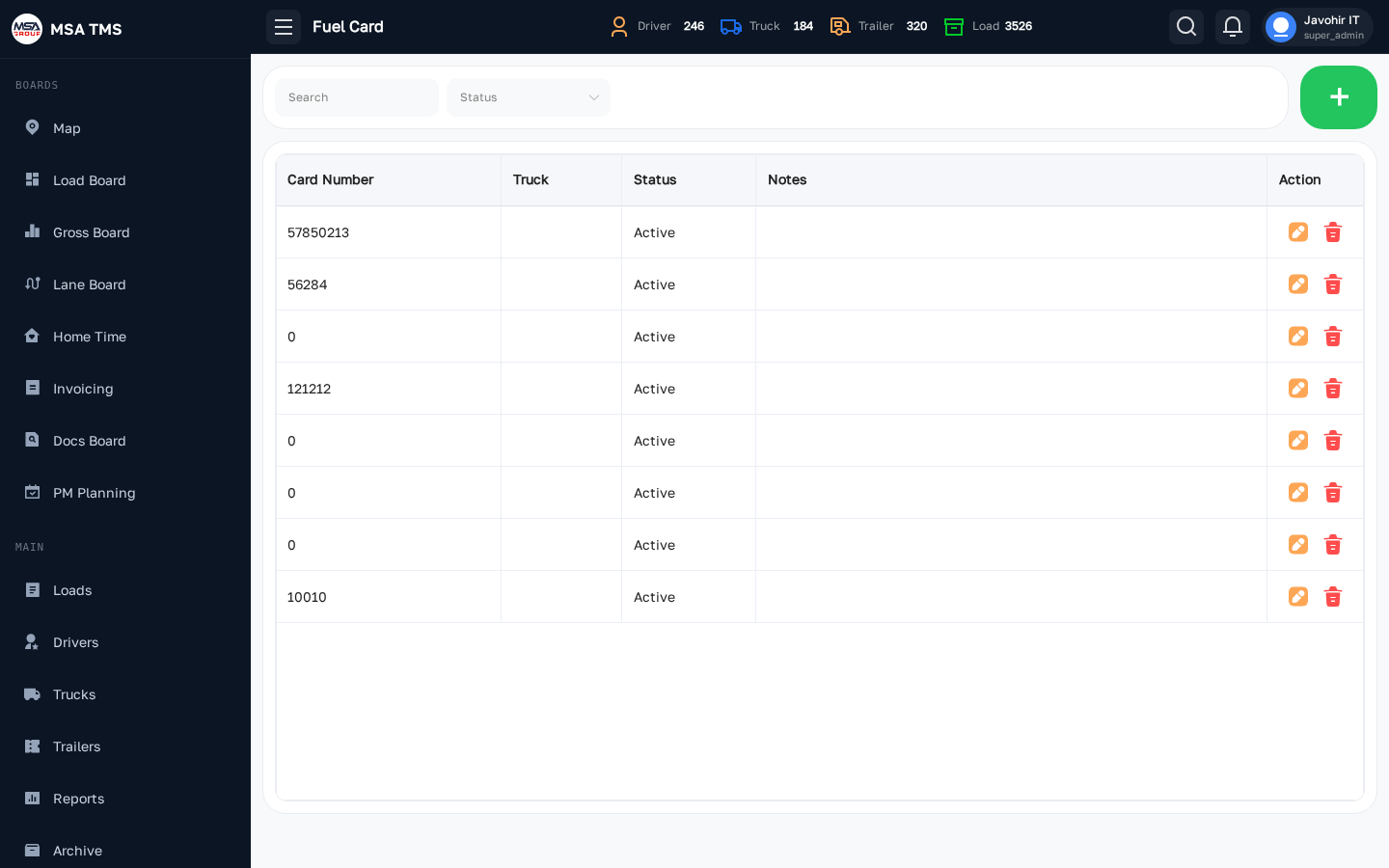
Manage the fleet's fuel cards (e.g. EFS, Comdata). Each card record links to a truck and a driver. Transactions imported from the fuel-card provider show here and feed Accounting → Fuel.
- Issue, deactivate, or replace a card.
- Set per-card daily or weekly spending limits.
Inventory
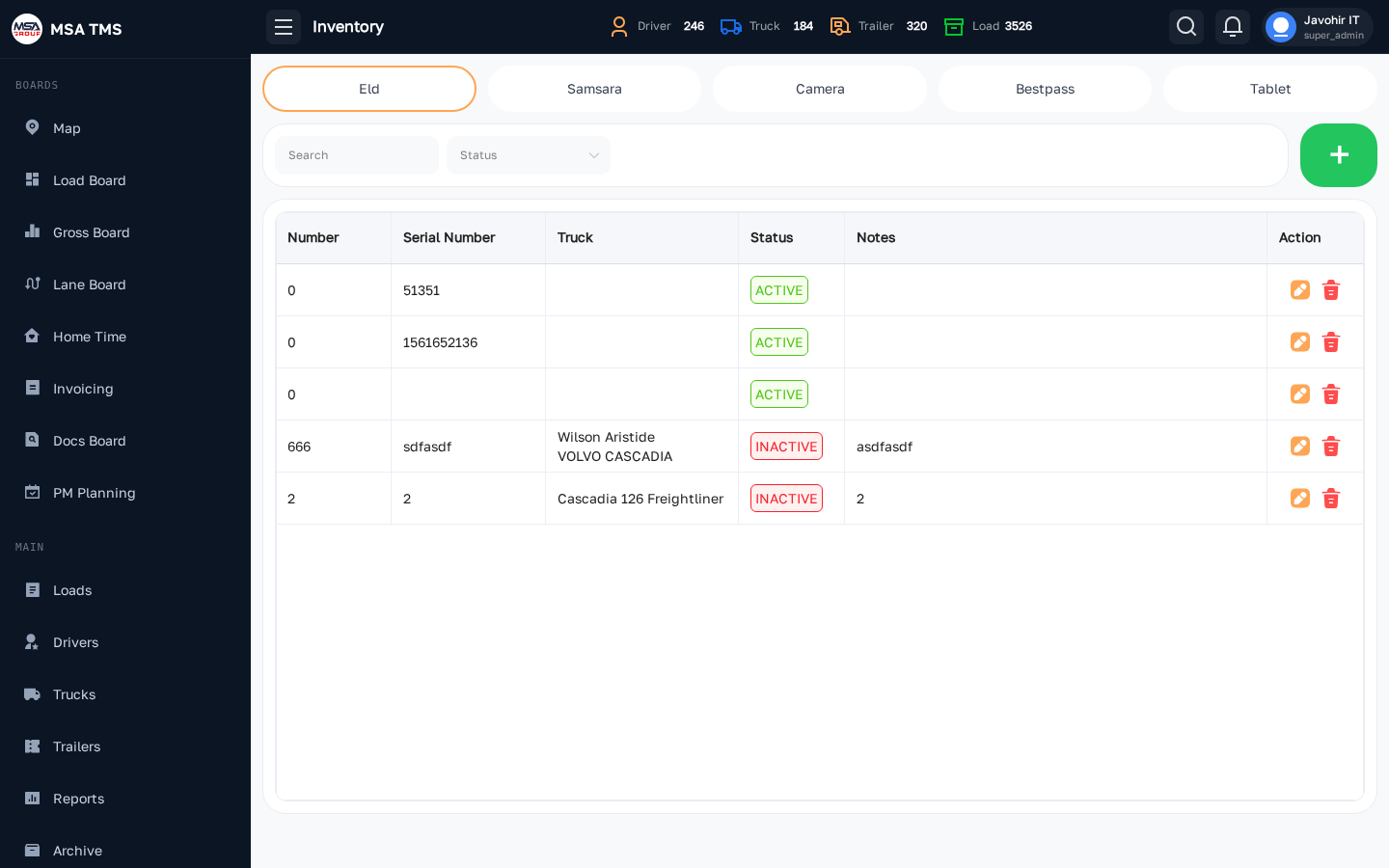
Parts and supplies on hand at your shop (filters, brake pads, tires, fluids). Use inventory to track what you have so a repair can be costed against it instead of always buying new.
Repair Shops
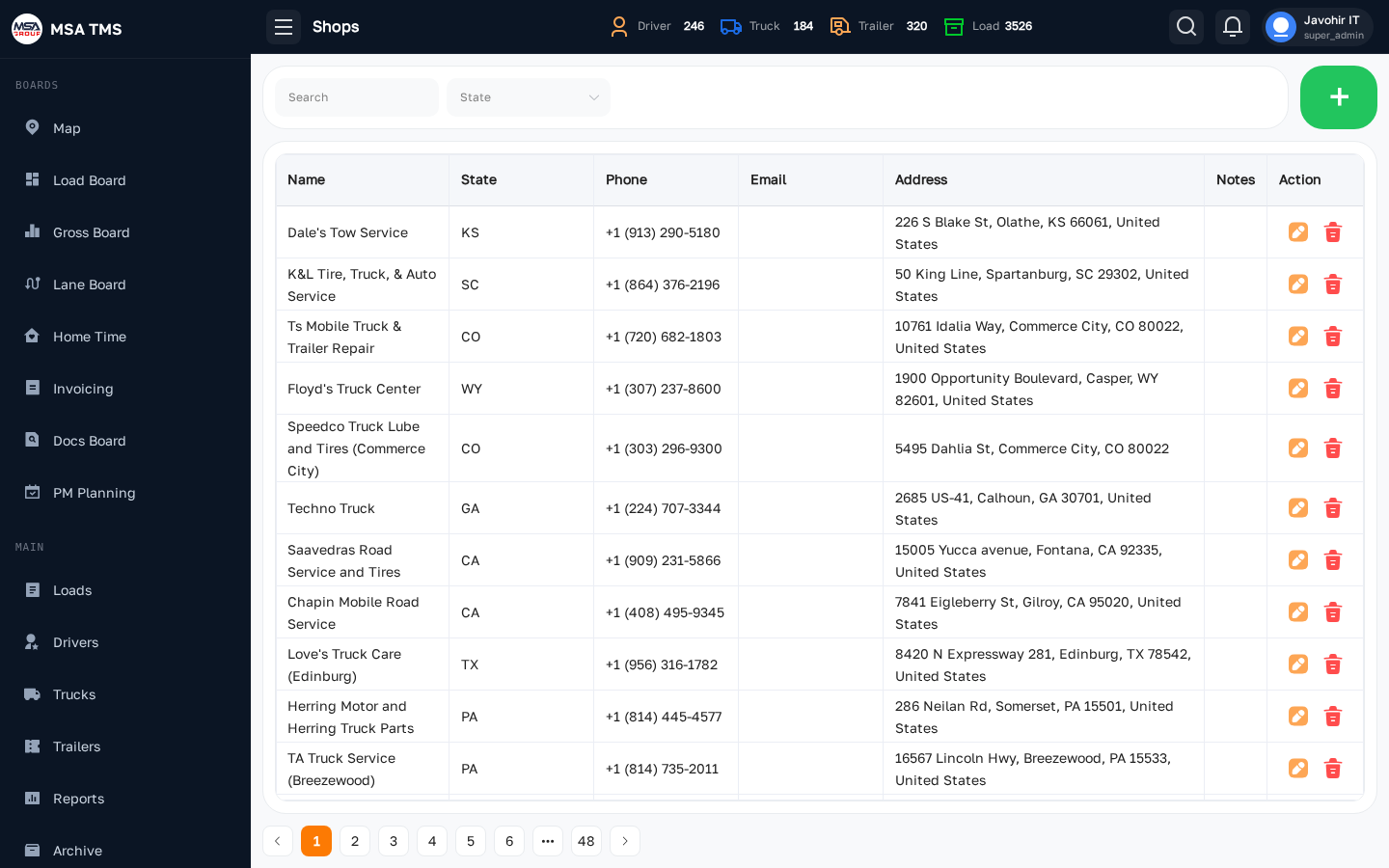
The directory of shops you use — in-house and 3rd-party. Each record stores address, contact, accepted payment methods, and labour rate. New repair tickets pick a shop from this list.
💵 Accounting
Toll
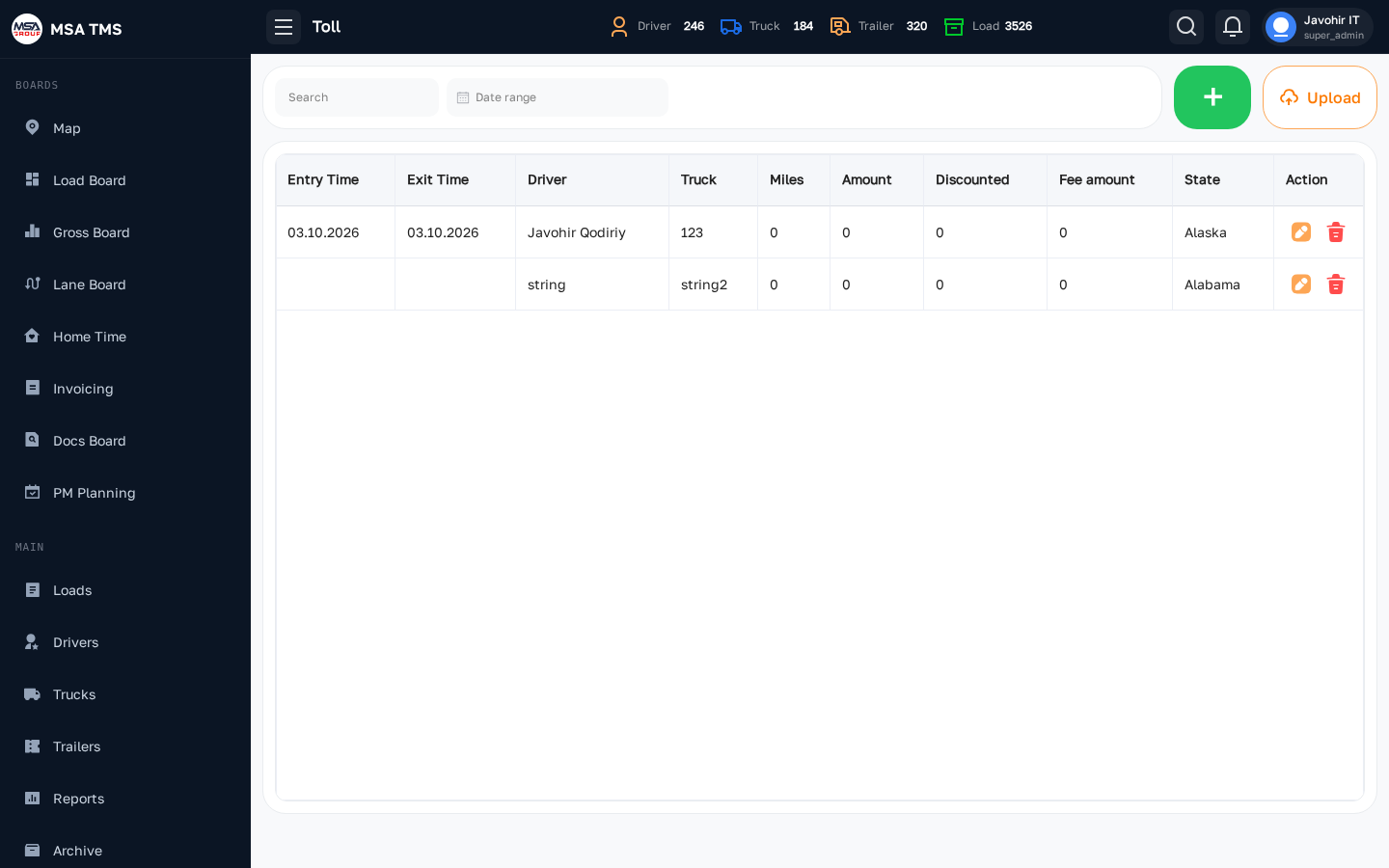
Toll transactions imported from Bestpass (and similar). Each row shows toll amount, lane, transponder, truck, and the load it should be billed against.
- Reassign a toll to a different load if it was auto-matched incorrectly.
- Export selected rows for reconciliation.
Fuel
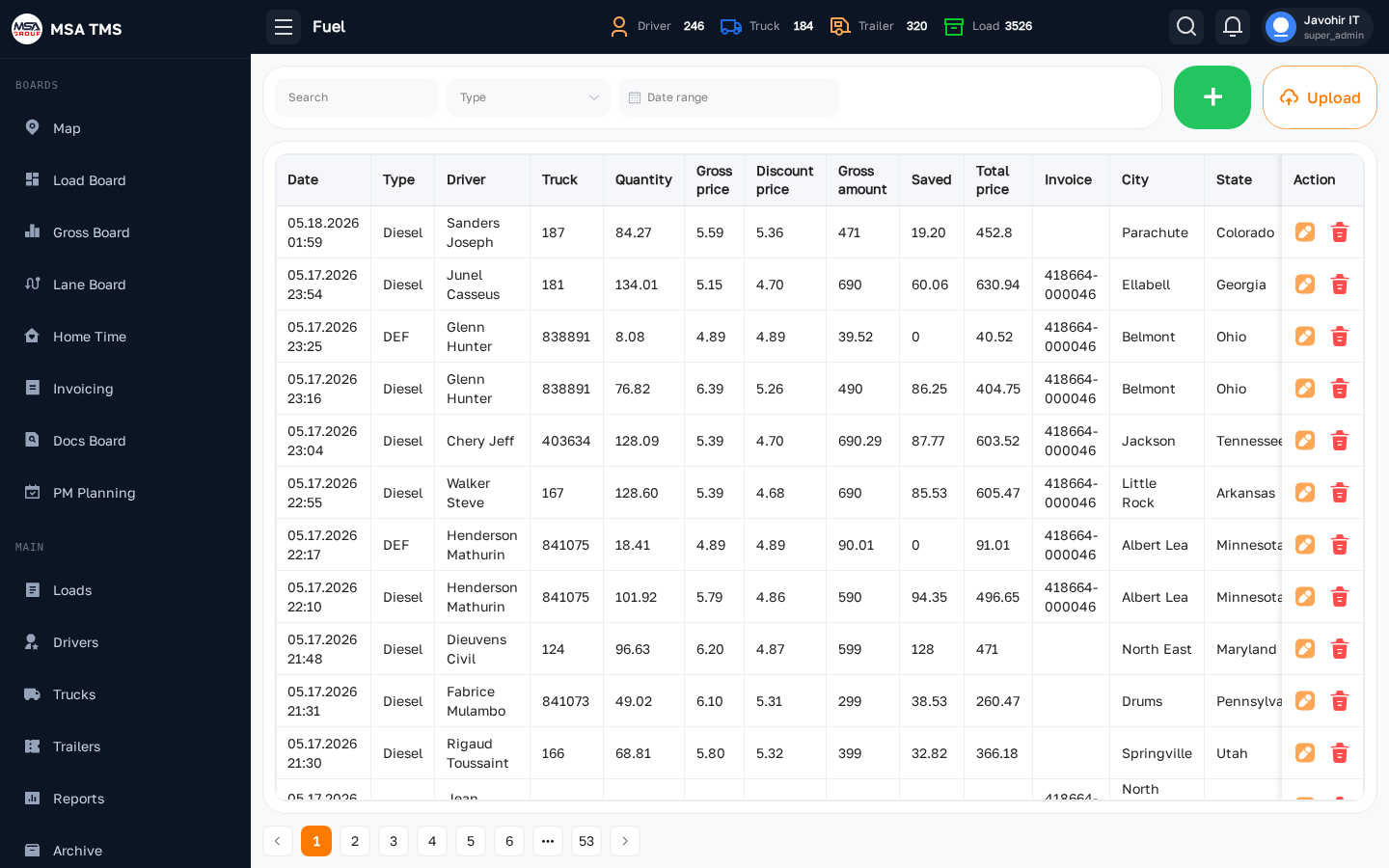
Fuel-card transactions, joined to drivers and trucks. Use it to spot anomalous spending (volume way above typical, unfamiliar location, mismatched truck).
- Filter by truck, driver, card, or location.
- Click a row to see the transaction in detail (gallons, price/gal, MPG).
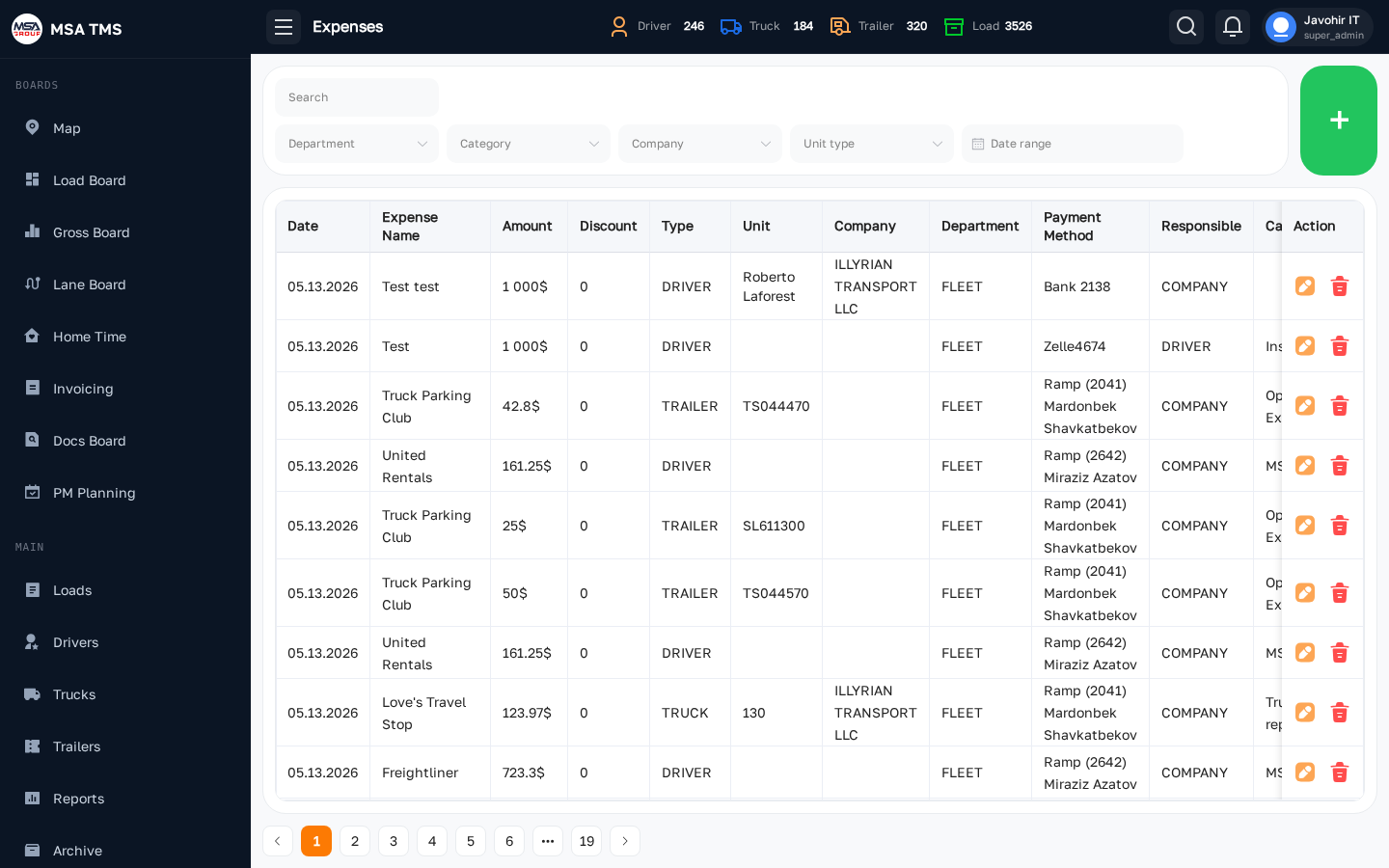
Expenses
The catch-all expenses ledger — anything that isn't a toll or a fuel-card swipe (Bestpass fees, IFTA, registration, deductions, etc.). Each line has an expense category, an amount, a date, and is attached to a truck, trailer, or driver.
- Add a new expense from the top-right button.
- Categories are managed in Settings → Expenses Categories.
🛡️ Safety
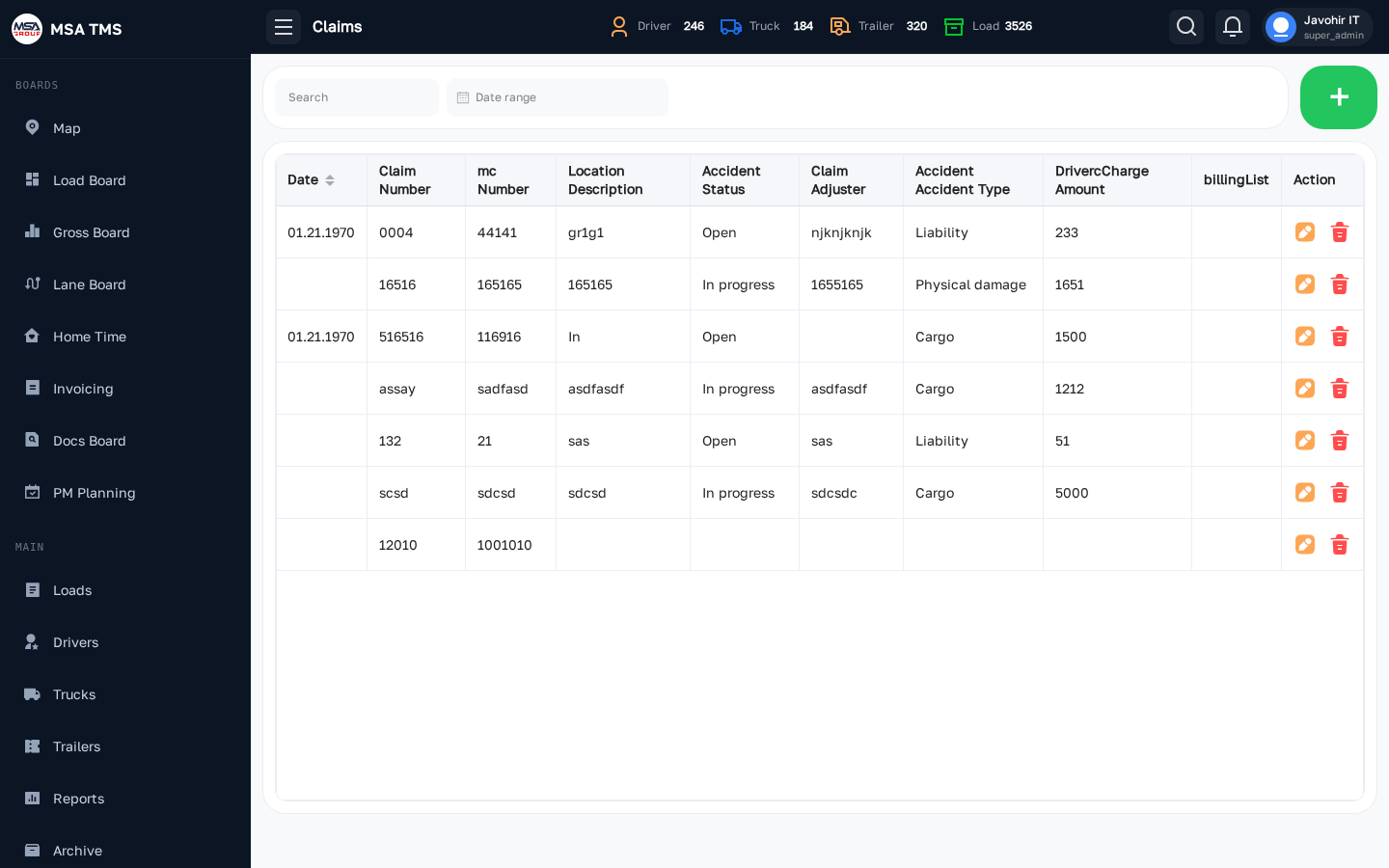
Claims
The accident / cargo-claim register. Each claim record holds the date, location, driver, truck, photos, police report, the broker's claim number, and the cost.
- Use the status workflow (Open → Investigating → Settled / Denied) to track resolution.
- Closed claims feed driver scorecards and insurance reporting.
⚙️ Settings
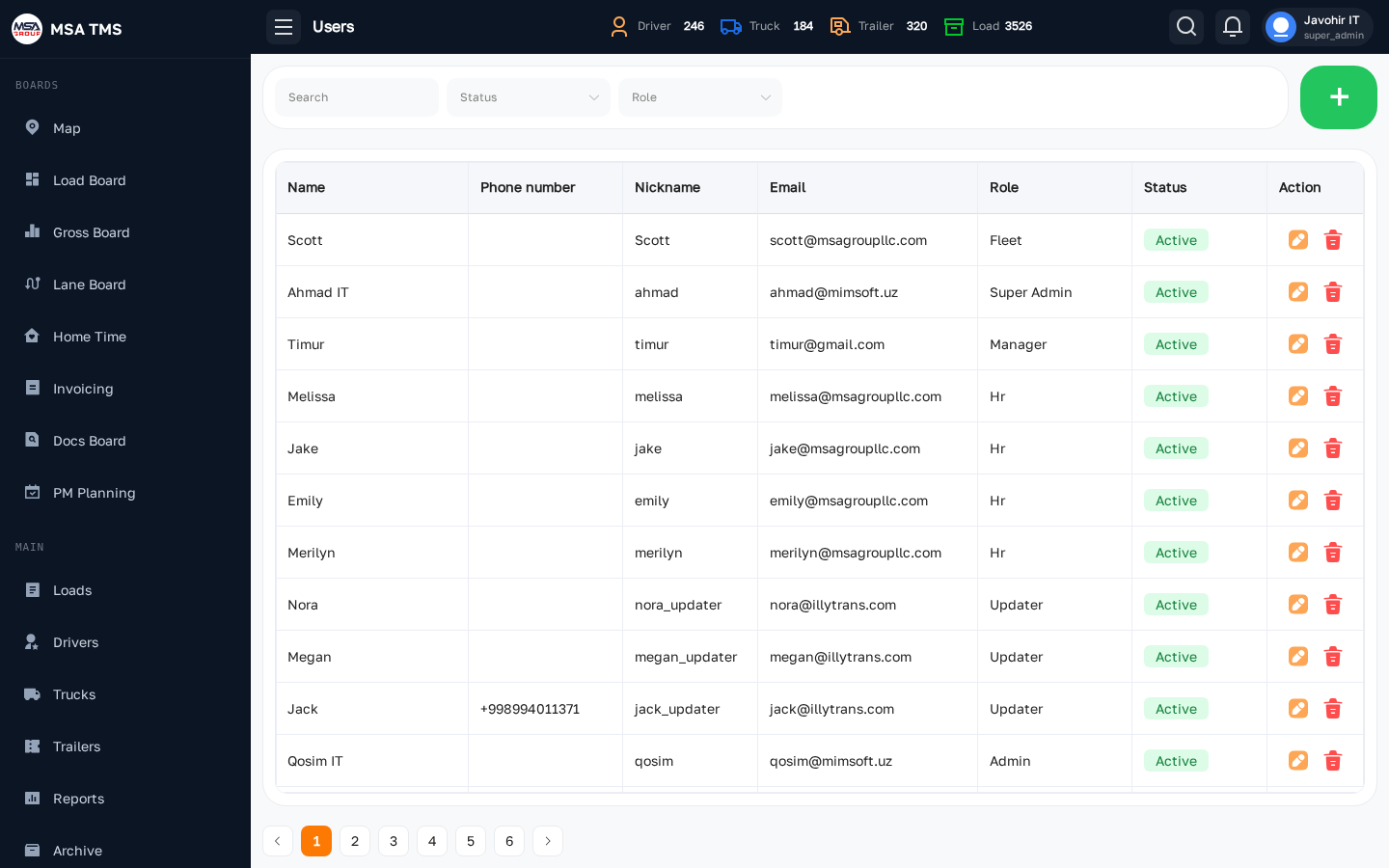
Users
Manage everyone who can log in: name, email, role, dispatcher team, status. Only
users with the SETTINGS_USERS_VIEW permission see this page.
- + New user — invite a new teammate.
- Click a user to edit their role, reset password, or deactivate them.
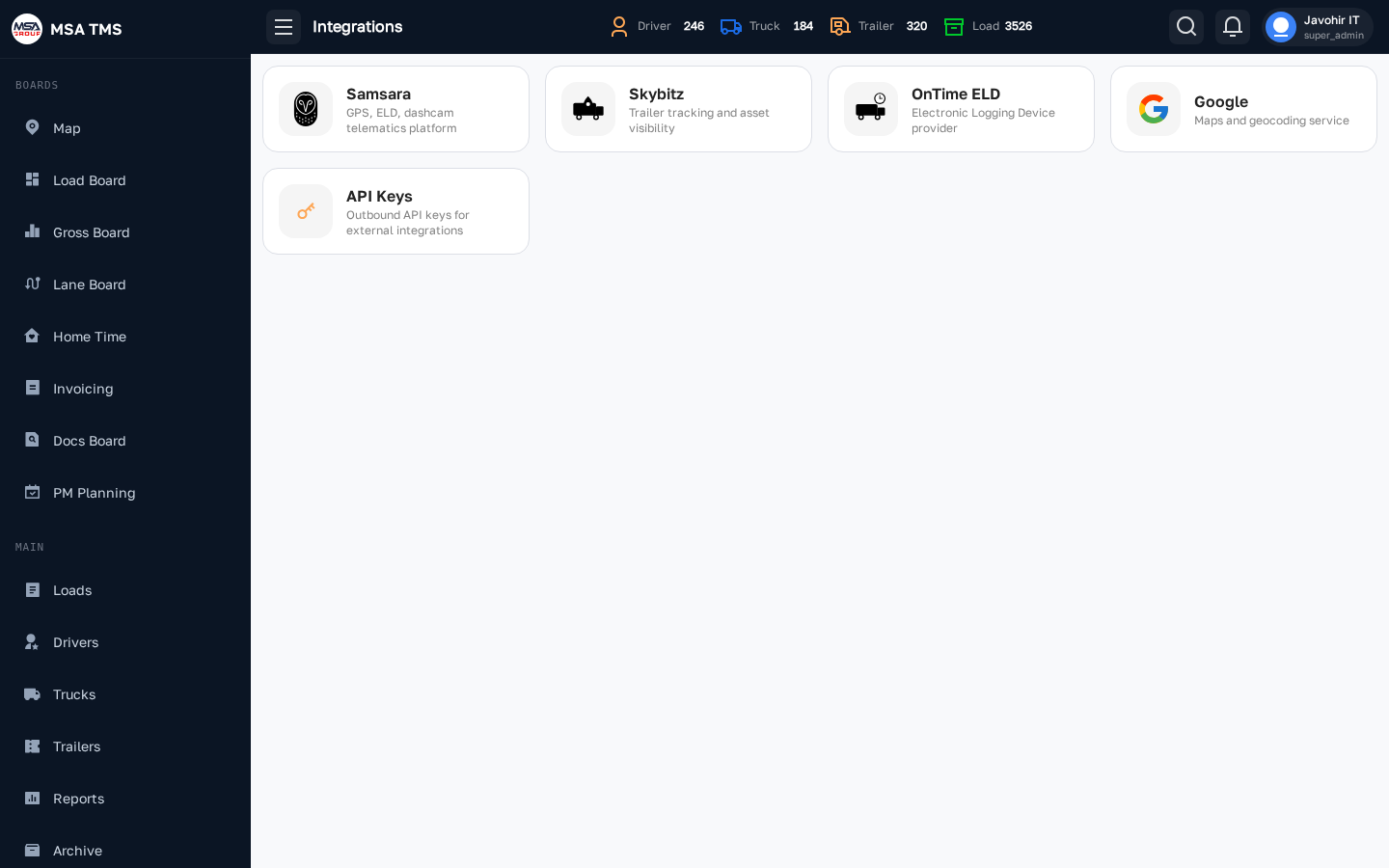
Integrations
Third-party integrations the carrier uses. The card grid surfaces Samsara, Azuga, SkyBitz, Bestpass, ELD providers, and Gemini. Each card opens its own settings screen where you paste in API keys and toggle features.
- Once configured, integrations populate the Map, Fuel Card, Toll, and similar pages automatically.
- Use the Test connection button on each card before saving.
Settings hub
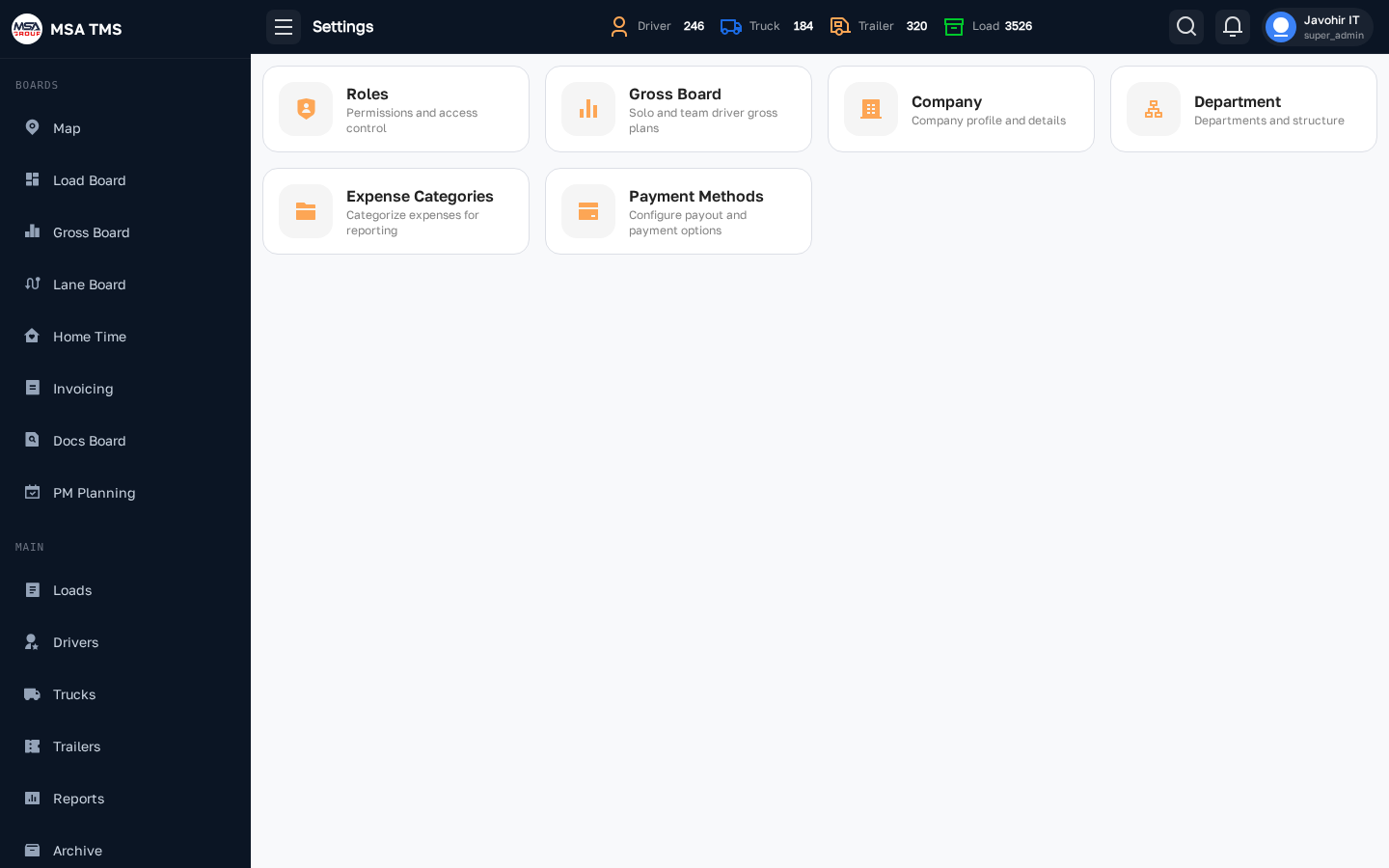
The catch-all settings grid. Each card opens a sub-page:
- Roles — define permission sets that get assigned to users.
- Companies — your own legal entities (DBAs / MCs).
- Departments — internal org chart used for routing and reports.
- Expenses Categories — the taxonomy used in Accounting → Expenses.
- Payment methods — ACH, Wire, Check, etc., used on broker invoices.
- Gross Board settings — the threshold colours and rules for the Gross Board.
📖 Reference
Load status legend
Every load row in the system wears one of these statuses. The colour and meaning are consistent across Boards, Loads, and Reports.
Permissions, in short
Permissions are resource-based — for each resource (Loads, Drivers, Trucks, Brokers, Fuel Cards, …) a role can have VIEW, ADD, EDIT, and DELETE rights independently.
The sidebar groups and buttons you see are filtered by permissions. If a screen or button is missing, ask an admin to grant the appropriate resource on your role under Settings → Roles.
FAQ
I don't see a sidebar item I used to have.
Your role's permission for that resource was removed. Speak to an admin who can update your role under Settings → Users / Roles.
The page won't load — it spins forever.
Check your internet connection first. The app needs to reach
api.tms.msagroupllc.com. If that's blocked by your network, the app will
route you to a maintenance page. A hard refresh
(Ctrl+Shift+R) clears most stuck states.
I edited something but the change doesn't show up.
The edit drawers send a partial update — the change is saved on the server, but you may need to re-load the page to see it propagate to other widgets (e.g. the Gross Board cache).
How do I switch carrier?
Log out and log back in. If your account belongs to multiple carriers, the picker shows up after you enter your password.
How do I reset my password?
Click Forgot password? on the login screen. You'll receive an email with a reset link. Reset links expire in 24 hours.
Which browser is supported?
Recent Chrome, Edge, Safari, or Firefox. The app uses modern JavaScript and may misbehave on Internet Explorer or very old releases.